


NOVA ESPERO CITY – SEPTO 25, 126 PM
In the Old City of Nova Espero, the ten-story, limestone Federal Credit Union building looms large over Meer Street. The employees within are responsible for controlling the Federation’s money supply and facilitating financial services for millions of Uniguitans, making the FCU the pre-eminent economic and financial institution in the country. A few blocks away on the Federal Way is the Federal Printing and Engraving Office, which prints each of the tens of billions of notes that are in circulation across the globe.
In addition to being vital parts of the modern economy, the FCU and FPEO are among the oldest institutions in the country, both being founded in Nova Espero shortly after the War. In those types of circumstances… what even was money?
The ration problem
In the earliest years following the War, there was no currency as we would know it today in Nova Espero. In those first few months, the vast majority of people’s days were spent engaging in subsistence scavenging, that is finding the necessary food and water just to get through the day. It wasn’t until a few months after the War that a few hundred survivors at the end of the Hegelion peninsula decided it would be better to band together than act independently. Organized crews were sent to specific zones in the wastes of Hegeliopolis to retrieve supplies, while others worked to set up a primordial postwar water system, some form of basic agriculture in old parks and boulevard medians, and a composting system that would ensure that waste wouldn’t totally go to waste.
Supplies scavenged from the wastelands outside of the early settlement’s walls were held in common, particularly food and emergency medical supplies. Eventually, an official rationing system was set up with each settler receiving “ration tickets” with each entitling the holder to a meal from one of the settlement mess halls. There was little to no differentiation in how much each resident got – guards got as much as farmers who got as much as waste collectors.
In addition to the bare essentials, some scavengers began to harvest non-essentials, primarily for themselves: vices like cigarettes, alcohol, and other drugs, but also creature comforts like playing cards, books, and even down pillows. Scavengers very quickly realized that people inside the walls very much wanted those “non-essentials” too. Some settlers – particularly those who had developed alcohol, nicotine, or other substance dependencies prior to the War – were even willing to trade ration tickets for a drink or a smoke.
This caused a number of problems very quickly. Not only did cases of alcohol poisoning and other overdoses increase, but illnesses related to malnourishment became more pronounced. People surviving on already bare diets of 1,400 calories were now subsisting on even less, which not only weakened them but made them more susceptible to infectious disease. Cholera, which had been stymied by the efforts of the settlement’s Public Health Division and food distribution efforts, roared back, as did cases of scurvy and jaundice. Though no one within the settlement had a diet that would be considered “healthy” prior to the War, the introduction of drugs and alcohol as well as the use of ration cards as currency quickly made the situation worse. More people in a diminished state meant that there were still many mouths to feed but too few hands to feed them.
The immediate solution was to introduce ration cards rather than tickets. Issued once per week, the holder would bring their card to a mess hall, and a hole would be punched in the appropriate box to show that the holder had gotten their meal. But even this system was exploited; cardholders would give their card to a seller, agreeing to give them one of their meals in exchange for a pack of cigarettes, for example. The seller would take their own card to one mess hall for one meal, and then use the buyer’s card at a different mess hall for another meal. Then the seller would give the card back to the buyer, who would typically give the card back to the seller in exchange for cigarettes, alcohol, or any other desirable good.
The Common Council responded with several new settlement regulations. First, the importation of alcohol specifically was to be dramatically curtailed. The amount that would be let in would be reduced only to the amount necessary to address the effects of alcohol withdrawal among those who had become dependent. Secondly, use of food ration coupons for anything other than rations would be strictly forbidden.
While the Council believed that these two policies would go a long way in restoring the situation, they recognized that residents, whether they liked it or not, were going to decide their priorities for themselves. To say that ration cards weren’t currency wouldn’t magically make them worthless for anything but food – people would continue to exchange them unless an alternative was introduced.
A new currency
Councilor, scavenger, and former employee of the Imperial Reserve Bank Abraham Reed had an idea. Instead of just banning what was happening already and hoping that would solve the problem, he proposed that the settlement print a new, primordial form of paper currency. Scavengers, farmers, and other settlement residents would be paid in the currency, and the Council would set aside time and space for guards and scavengers to sell their non-essential wares in a public setting. Thinking into the further future, this currency could be used to establish trade with other settlements, and eventually, pay and collect taxes. This paper money would be backed by gold coins harvested from damaged bank buildings nearby – existing Imperial paper money was deemed too common and too devalued by the sudden population loss to be worth anything – which would then be stored within a newly formed Bank of Nova Espero.
The Common Council broadly approved the plan, though they took issue with the title of “Bank.” Instead, for their new, more egalitarian society, they preferred to call the institution a “Credit Union,” though it would largely function as a normal central bank in terms of authority and leadership.
To determine the proper pay amounts for each member of the community, Reed brought together the leadership of the Scavenger’s Union, the Public Health Division, the Farmer’s Union, and the other major proto-employers in the settlement. Over the course of a three-day meeting in the summer of 1 PM, they hammered out a universal pay schedule for settlement workers that would ensure differentiation for ability, responsibility, and merit, but also avoid the starkly stratified class-structure that had formed prior to the War.
After weeks of printing – Reed only had three copies of the stamps used to produce the bank notes, so he and his two assistants had to handmake them all by themselves – the first “payday” came on Deka 4, 1 PM. In addition to their ration cards, scavengers, farmers, and Reed himself received envelopes stuffed with “notes,” the newly minted paper currency.
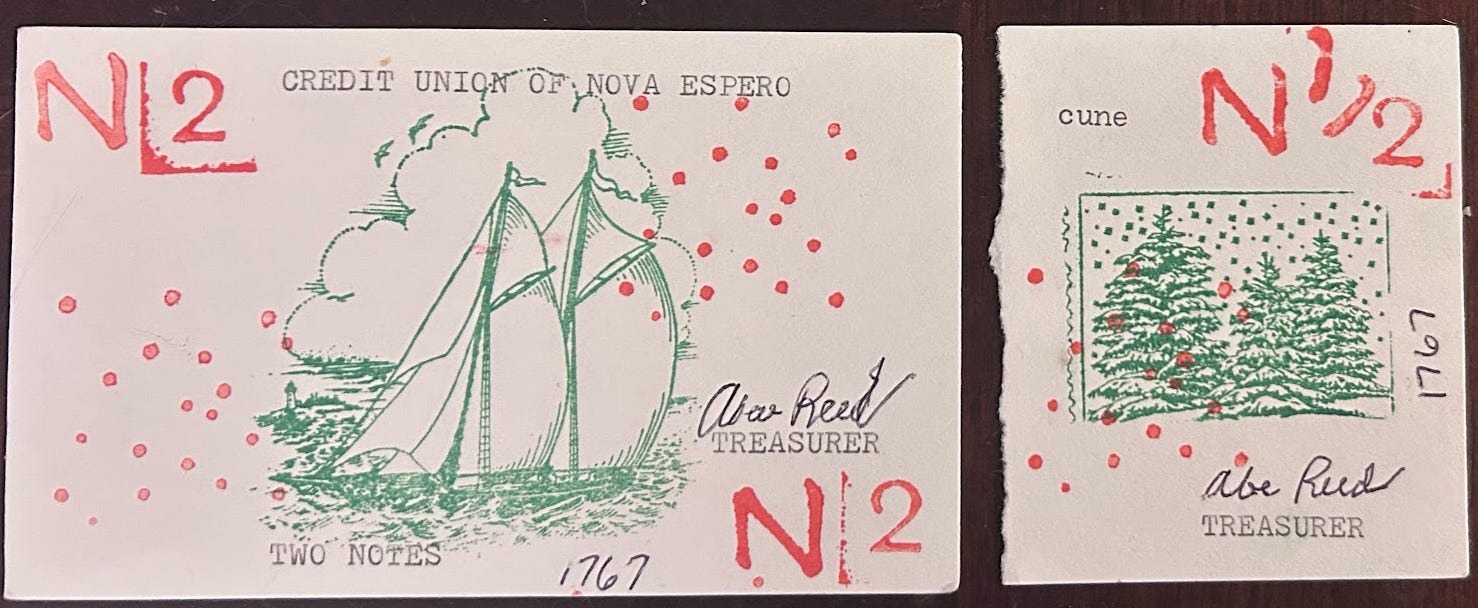
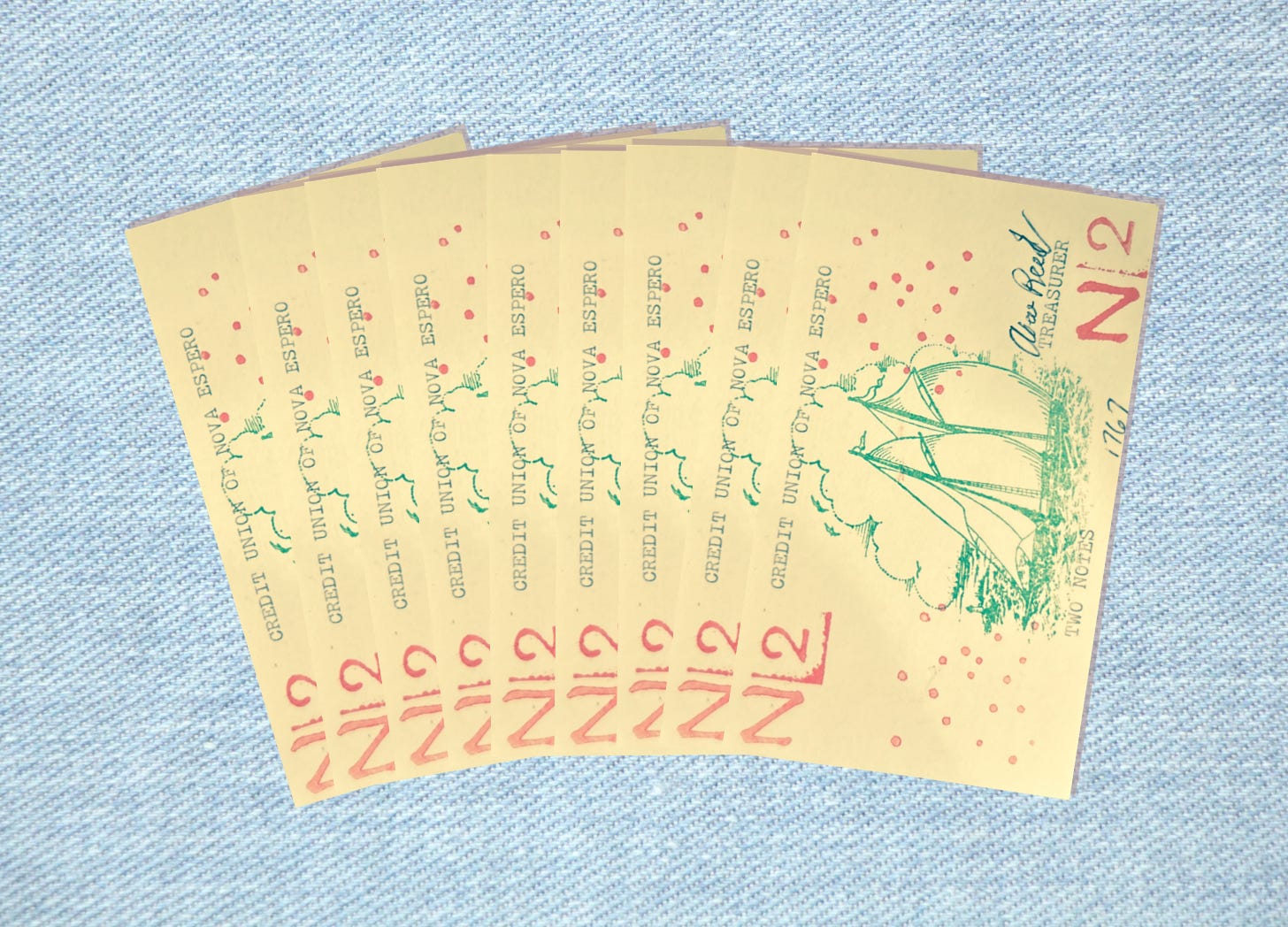
These original notes were extremely bare-bones, with stamps directly printed on index cards accentuated with typewritten text, the year of printing, and Abraham Reed’s signature. Reed and the Council knew that these original notes were far from foolproof, but they assumed that they would suit their purpose until a more permanent solution could come about.
Initially, the residents of Nova Espero were skeptical. Despite being backed by gold, the new paper money was still abstract in its value compared to, say, individual meals at the local mess. It wasn’t until around a month later that Reed himself became fully convinced. In a Dekaunuo 13, 1 PM entry in his diary, he wrote:
“Earlier this evening as I was retiring to my quarters after dinner at the Hornby Street mess, I came upon two men rifling through the pockets of some drunkard incapacitated on the pavement. Peering from behind a lamppost, I witnessed them pull out a wad of notes, plunging them into their own pockets. To thieves, at least, our notes have value yet.”
Notes had become a widely used currency for all sorts of “non-essential” goods – that is, everything except food, medicine, and shelter. The markets held during evenings saw the notes change hands, and residents began using the notes to charge for services when they weren’t performing their regular work details.
Once sufficient improvements had been made to the city’s hydroponic and other agricultural infrastructure, labor was put to other uses. Using the capital generated by the Credit Union and materials scavenged from abandoned buildings, some started construction businesses to build stronger, more durable rowhouses, apartment buildings, and storefronts. A nascent glassmaking industry started producing replacement window panes, artists began to paint again, and specialized trades workers began to peddle their services. All of this created new uses for the notes, and circulation further increased.
In 4 PM, Ferrian trader Rene Lorenzo remarked:
“Every street in the settlement core lined with some sort of market, or some individual selling something – books, cigarettes, old magazines, and even things we never saw in Puerto Ostra. Dried tea still in tins, preserved coffee, as well as kettles and mugs with which to brew and drink them. Candies, toy cars, and dolls, as well as typewriters and fine vintage works of art. The Esperan diet when it comes to staple goods and nutrition is no different than ours was [...]. But the Esperans are no worse for wear. In fact, they possess an energy and spirit that I had never seen in Puerto Ostra. They are hungry, but they live and breathe as though they are striving and rich.”
This increased velocity created an issue: deflation. Because the notes were backed by a finite supply of gold coins, the number of notes themselves was finite. In late 2 PM, Reed convinced the Common Council to offer up a bounty for gold coins retrieved from the wasteland. The Treasury would pay scavengers N0.75 for each coin brought to the Credit Union, building the settlement’s gold supply and generating new notes. Soon enough, scavengers were bringing in hundreds of doubloons each week.
Despite its successes, this system was not without its shortcomings. On Dekaduo 18, 2 PM, a crew of five scavengers ambled up the steps of the Credit Union building bearing a large chest, “some three feet wide, two feet tall, and two feet deep, and bearing some considerable load” according to Reed’s account of the event. Dumping the crate on the floor in front of Reed and his two clerks, the men claimed they had found it in a mansion they had scavenged around a mile from town. “The men – no more than twenty years of age – bore mischievous and greedy smiles on their faces,” wrote Reed.
Opening the chest revealed it to be full of Imperial gold coins. After a four hour long count, Reed and his clerks found 79,802 coins in the box – a nearly N60,000 payout. This would have been equivalent to four weeks of the settlement’s total outlays, and given the men’s average weekly wages of N15, more than fifteen years’ pay. Paid out all at once, it would single-handedly create a minor economic crisis.
Instead, Treasurer Reed told the men that he would write up a note guaranteeing them a N50 payout that day – almost twice the top wage in the entire community – and N20 every week for the next fifteen years. The men’s disappointment at not instantly owning the entire settlement economy was sated by the idea of more than doubling their pay for the next fifteen years, which in the times immediately following the War, might as well have been forever.
Among these men was Pieter Rensselaer, a former shipyard worker who saved his weekly payout and ended up using the funds to found Rensselaer Shipbuilding, a company that continues to be the largest shipbuilder in the Federation today. Another, Thomas Hyacinth, used his winnings to build what would later become Nova Espero’s largest homebuilding company.
More than six decades later, Rensselaer’s son Benjamin would helm his shipbuilding empire amid the historic Great Cruise Ship race between Uniguita and Ylrikia. You can read more in Part One of the Dispatch’s series on the race.

Following unification and the foundation of the Federation in 5 PM, the note spread throughout the southwest of continental Kagzmerak. Banks and credit unions spawned across the region, with (much more professionally made) bills flowing out the door of the newly formed Federal Printing and Engraving Office (FPEO). Factories and mills were re-opened and rebuilt, and some semblance of a complex and sophisticated economy began to re-emerge. Today, notes are used by tens of millions of Uniguitans, and are a major exchange currency for international trade.
Abraham Reed oversaw the Credit Union of Nova Espero – now the Federal Credit Union – from its creation until his death in 31 PM. In his lifetime, the FCU and FPEO expanded from three employees hand-stamping notes in an old bank to a monetary policy juggernaut with massive printing presses putting out tens of millions of notes per day. A fresh-faced, junior-level economist with the Imperial Reserve Bank prior to the War, Reed had overseen the creation of a massive, modern, and highly professional financial institution and a currency that ensured Uniguita would be an economic powerhouse.
Upon the 30th anniversary of the FCU and shortly before his death, Reed wrote that, “before the note, we traded beans for bandages, tools for tobacco, and medicine for powdered milk. And then we had the note; and after that, we had civilization.”