


PORT WILLIAMS, N.H. – TRIO 3, 126 PM
At Pier 15 in Port Williams’ storied harbor, tearful passengers drag suitcases down gangways, briefly looking back to gaze upon the towering Amity behind them. 1,128 feet from bow to stern and with a capacity of 4,000 passengers, the gigantic cruise liner plodded the several thousand miles between Port Williams and Ylrik City for decades. Sunset Hospitality, which acquired the liner in 111 PM, says that it plans to keep the liner at a nearby pier permanently as a portside luxury hotel after an extensive retrofit that would see its history-making nuclear engine ripped out and replaced with more space for spas, boutiques, and theaters.
This last call to port marks the end of a long and fascinating narrative in nautical, technological, and even geopolitical history. As a ship responsible for so many memories sets down its anchor for the final time, it’s worth retelling the history of this fascinating vessel.
War and peace
After the Sherbrooke War ended in 45 PM, tensions remained high between Uniguita and the Ylrikian Empire. Relations were further inflamed after the latter’s first, post-Milito test of a significant explosive device (SED) in 53 PM. Two years later, Uniguita followed suit with a test of its own. Renewed fears over a second SED war little more than half a century after the Milito nearly destroyed all life on the planet generated a significant anti-SED protest movement that helped define politics in the West in the late 50s.
One of the leaders of this movement was Conservative Common Councilmember Fernando Pelar. Like many at the time, Pelar was the son of victims of the Milito, specifically a couple that survived the cavalcade of missiles that destroyed Puerto Blanco. As Pelar eventually came into politics, he became an active and outspoken opponent of redeveloping SEDs, lending his support to a 51 PM motion to ban their research and development within Uniguita entirely. Though the bill obviously didn’t pass and Uniguita did end up rebuilding the bomb, Pelar remained obstinate in his commitment to disarmament.
Ahead of the 60 PM primaries, Pelar became the friendly face of a Conservative Party still reeling from the consequences of party leader President Enrico Carmelo’s attempted coup in 47 PM. An anti-SED former businessman provided a contrast to the Populist Marco Paleda, a lifelong bureaucrat and staunch supporter of the incumbent administration. Pelar won over a new renegade constituency of liberal-conservatives who supported traditional values, low taxes, and geopolitical détente. Despite only narrowly nabbing the Conservative nomination, Pelar ended up winning the 60 PM presidential election convincingly. Pelar promised a “new day” for Uniguita, and sought to turn the page on the country’s past struggles and rebuild transcontinental communications.
Meanwhile, Ylrikian Emperor Katsuhito pursued an aggressive foreign policy. After the Empire’s loss in the Sherbrooke War, he shored up occupying forces in the Crescent Islands, Bawguk, and the Central Mountains while expanding the Imperial Navy. Katsuhito pushed for redevelopment of SEDs, and proudly boasted about them on the international stage. At a 59 PM meeting of the Continental Union, he said that his nation’s bombers could, “cloud the Western skies with smoke before their pilots even rolled out of their barracks.”
There could be no men more different than Katsuhito and his son Asahi. Unlike Katsuhito, a longstanding military officer and lieutenant to his own continent-conquering father, Asahi was much more interested in economics and diplomacy than war. During his requisite military service, then-Prince Asahi spent time in the Ylrikian backcountry and was taken aback by the crushing poverty. When he visited Uniguita in 51 PM as a part of his studies, Asahi was astounded at the Federation’s comparative abundance. He wrote in his diary.
“Here, the children of farmers do not suffer the humiliation of hunger and deprivation. The hamlets are obviously less prosperous than the cities, but even a rural fruit stand here is more replete with produce than a typical grocer in the Imperial Capital. The school in this village has more resources and a more competent instructor than most schools even in our middle class districts. It is a wonder that we have an Empire at all.”
Because of the difference between the two men, Katsuhito’s sudden death in 62 PM served was a geopolitical earthquake. The newly crowned, 33-year-old Emperor Asahi had no interest in pursuing his father’s revisionist foreign policy. Instead, he sought a liberalized economy bereft of its ancient, ossified Crown corporations and landlords, and rapprochement with Uniguita to facilitate open trade. In an address following his coronation, Asahi called for the “light of the coming glorious sunrise to burn away the icy walls of enmity.”
When President Pelar and Emperor Asahi met for the first time in 63 PM for preliminary trade and arms reduction talks, the two got along well. When revanchist imperialists attempted to overthrow Asahi in 64 PM, Pelar lent valuable intelligence support that led to the coup’s ultimate failure. On the heels of this failed insurrection, Asahi was able to sideline the old nobles and replace them with an ascendant industrial, merchant, and political class that would supercharge the Ylrikian economy and supply the membership of his new Imperial Parliament.
This same parliament would help ratify the Continental Arms Reduction Treaty of 64 PM (CART 64), which prohibited Uniguita and Ylrikia from further developing SEDs for the next twenty five years, and created a timeline for the destruction of current weapons. The document also, importantly, barred both powers from building new nuclear-powered warships.
At the time the treaty was signed, the governments of both nations had the construction of a number of such warships under contract with a variety of shipbuilders. Some chose to pivot, selling the reactors to universities and institutes for research, or to backcountry utilities as an efficient option for rural electrification of low-population areas.
Others had a different idea.
‘Game on’
Shortly after CART 64’s ratification, Uniguitan shipping magnate Benjamin Rensselaer met with Ylrikian shipping magnate Hiro Shimizu at a hotel in Madawba. Both men had two issues – surplus nuclear reactors specifically designed to power ships, and no ships to power them with. And while détente helped create a new peace, this new peace was detrimental to the bottom lines of these giants of their countries’ military-industrial complexes.
At the same time, both saw an opportunity. Prior to the Milito, cruise liners had been a booming industry, with the various shipbuilders of the world competing to build the best cruise ship possible. Rival Ylrikian and Hegelio-Ferrian companies regularly raced ships across the Great Western Sea to show off their nautical acumen, creating a strong – but pacific – competitive spirit between the two countries’ seafaring enterprises.
In the decades following the Milito, both Uniguita and Ylrikia had built river cruises or liners meant for intra-national travel along their own coasts. But they hadn’t explored transoceanic travel in the same way pre-Milito companies had.
Now, with a series of nuclear reactors just waiting to have ships built around them, Rensselaer and Shimizu saw a chance for a comeback. The two agreed to stage a friendly competition between the two shipbuilding giants – they would see who could build a ship the quickest, and then in a simultaneous time trial, who could travel between the two countries’ capitals the fastest.
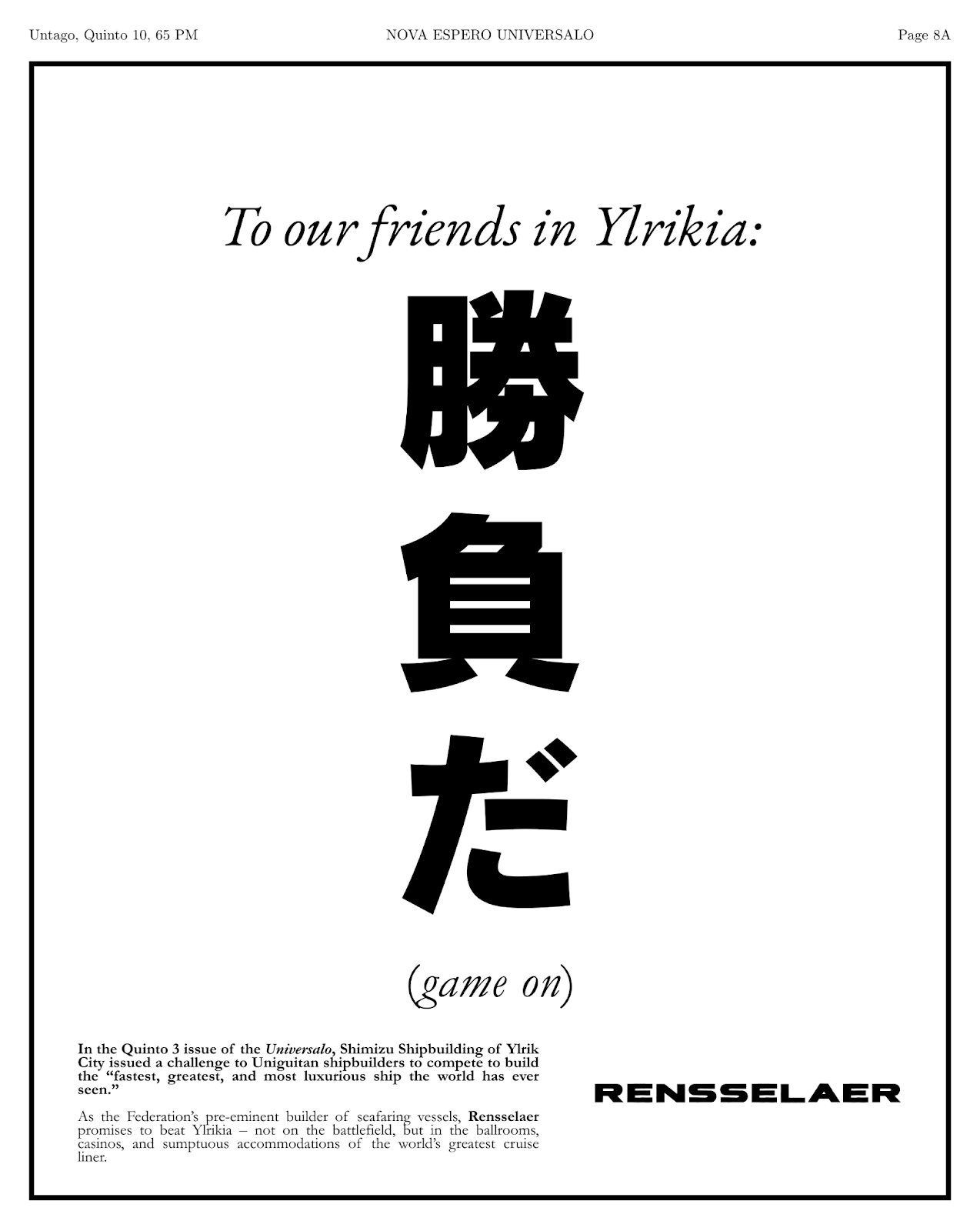
Even before they had lined up the funding for their projects, the two companies built hype by announcing the competition. On Quinto 3, 65 PM, Shimizu placed a full page ad in the Universalo challenging the Federation to compete to build the, “fastest, greatest, and most luxurious ship the world has ever seen.” There were only three rules: the ship had to be at least 1,000 feet long, it had to have a passenger capacity of at least 4,000, and it had to make use of a nuclear-powered engine.
A week later, Rensselaer published its response in the Universalo and the Ylrikian Teikoku Shimbun: shōbu da – “game on”.
Media coverage increased, and both companies began working on their respective liners. Soon enough, the governments of both countries became interested in the competition. In Uniguita, the Common Council dedicated N5,000,0001 – about N18.7 million today – to building Rensselaer’s entry, the Amity. Ylrikia committed a similar sum to building Shimizu’s Shinzen (“goodwill” in Ylrikian) project.
The two countries got involved in what was nominally a private competition between various shipping magnates for a number of reasons. The first was technological. Even though CART 64 prohibited putting nuclear-powered engines in warships, the treaty would only remain in force for twenty-five years. Further testing would not only give each navy an advantage when the treaty eventually sunsetted, but would also lend itself to commercial uses in the merchant fleets that were expected to grow alongside expanded trade between Uniguita and Ylrikia.
The second was political. With a drawdown in naval shipbuilding contracts, thousands were expected to be unemployed in Uniguita’s populous coastal cities like Port Williams. Funding such a project would provide temporary employment, and would help staunch any potential resentment that unemployed dockworkers would feel at the polls in the next elections. Even in Ylrikia, which was far from a democracy – Parliament was only open to members of the newly-founded Loyalty and Prosperity Party, which was itself a fairly elite, exclusive organization – Emperor Asahi knew that immediately laying off thousands of dockworkers might damage the legitimacy of his still very fresh reforms and strategy of economic over military competition.
The final reason was purely symbolic. After Ylrikia’s defeat in the Sherbrooke War twenty years prior, there was a sense that the Empire could use a win. Asahi and his advisors were confident that Ylrikia, with its larger population and mercantile history, would eventually come to outcompete Uniguita economically. He and his advisors foresaw Ylrikia’s victory in this competition as the opening salvo in a new era of Ylrikian ascendancy. Pelar and the Uniguitans, meanwhile, saw the competition as a way to reaffirm the Federation’s economic and technological supremacy.
With government and private support, Shimizu and Rensselaer began construction in earnest. The two became celebrities in their respective countries, as did the projects’ leads. In a temperamentally conservative and reserved culture, Shinzen’s Fuku Tanaka was unique in being a jovial, charismatic, and eminently telegenic figure. At the same time, Ylrikian audiences revered his proven technical expertise, impressive credentials as a longtime naval engineer responsible for some of the Empire’s most advanced warships, and regular project updates that became must-see television.
The Amity’s Sandra McMaster, meanwhile, stood as a symbol of the Uniguitan Dream. The tenth of eleven children from a poor family from the swamps of Swalabash, McMaster came from nothing to become one of the most accomplished individuals in maritime history. Responsible for designing several of the ships that eventually helped Uniguita win the Sherbrooke War, she became a national hero. As a self-described “reformed warmonger”, her professed hope for more peaceful relations between Uniguita and Ylrikia folded in neatly with the country’s new geopolitical outlook. And being a woman, she provided a more egalitarian contrast to the male-dominated world of Ylrikian industry.
For the next two years, construction continued. In Ylrik City, Shimizu’s workers labored for countless hours of overtime, oftentimes clocking over 80 hours a week driving rivets, welding beams, and installing the ship’s hundreds of staterooms. While this working style was a boon for the rate of progress, it created hazardous working conditions – on Unuo 14, 67 PM, three workers were killed and dozens more were scalded in a steam explosion aboard the ship that likely resulted from hastily welded valves. Four months later, seventeen workers were killed and nearly forty more were injured when a scaffolding platform gave way. Over two-hundred other workers were injured in falls, collapses, and other workplace incidents. On the 30th anniversary of the ship race, one Shinzen worker later told the Universalo that working conditions on the jobsite reminded him of “the slavery that built the vast Ylrikian temples centuries ago.”
“They drove us to work impossible hours with impossible speed,” he told the paper in 98 PM. “Simply put, it was all impossible. It only got done despite the impossibility of the circumstances.”
In Uniguita, meanwhile, Rensselaer faced its own setbacks. The largely unionized workforce of Port Williams demanded shorter hours, higher pay, and safer working conditions. This ensured that the workers were better compensated and safer than their counterparts in Ylrikia – only three died during Amity’s construction – but it slowed progress and caused construction costs to balloon over the lifetime of the project. Originally projected to cost just N36 million2 in today’s notes, the project finally cost just over N51 million3 at completion.
Further exacerbating timeline and cost issues were conflicts early in the construction process between Western and Eastern workers. The Western-dominated Shipbuilders Union was hesitant to enlist the help of the significant Ylrikian and Crescent Islander diaspora communities in Port Williams, alleging that they would sabotage the project in the interest of the Ylrikian Empire and put downward pressure on the unionworkers’ wages. Just weeks after construction started, members of the Shipbuilders Union attacked arriving Ylrikian- and Islander-Uniguitan workers, leading to dozens of injuries and hundreds of arrests.
Eventually, the federal Constitutional Court intervened, ordering the union to accept non-Western members and to halt all attempts at blocking workers of Eastern heritage from entering the jobsite. Even so, the entire situation served as a black eye for the project and a propaganda victory for the more nationalist set in Ylrikia. The ultranationalist Irikkoku Shinbun chastised their Uniguitan competition, pointing out the hypocrisy of Uniguita’s stated egalitarian values that conflicted directly with what was essentially a race riot.
For more on the Ylrikian- and Islander-Uniguitan communities in Port Williams, read the following Dispatch on the modern diaspora’s reaction to the Crescent Islands’ potential withdrawal from the Ylrikian Empire.

Ylrikia scored a major victory on Septo 19, 67 PM when Shinzen was the first of the two ships to launch. Hundreds of thousands flocked to Ylrik City’s port to see the cruise set off for the first time, a victory and goodwill tour around the Empire’s island possessions. The Teikoku Shimbun published a breathless review of the ceremony, saying that the launch “marked the beginning of a new Century of Ylrikian Excellence, and the first of likely endless triumphs of Ylrikian industry.”
The Amity, confronted with the aforementioned delays, wouldn’t launch until Dekaunuo 2, 67 PM. “While the Shinzen slipped from its berths amid the beautiful sunshine of an Ylrik City summer, the Amity slinks away through the bitter winds and driving rains of a Port Williams autumn,” wrote one columnist from the Universalo.
Broadly speaking, however, initial reviews of the Amity were positive. It was a feat of modern engineering, and its luxury was unrivaled. In trial cruises along the Federation’s sunnier Gold Coast, tourists, maritime professionals, and public officials all lauded its state-of-the-art accommodations, bountiful entertainment, and breathtaking speed. The same columnist from the Universalo wrote of the ship that, “despite its tardiness, the Amity is a monument to Uniguitan commerce, innovation, engineering, and imagination.” He contended, “that there exists no greater representation of the Spirit of Uniguita than a costly, over-schedule, truly groundbreaking and unrivaled piece of nautical architecture.”
In early 68 PM, Shimizu and Rensselaer agreed to a timeline for the final race. Both ships would depart their respective capitals, and would then have to plod across the Great Western Sea (or, Great Eastern Sea, from the Ylrikians’ point of view) to the rival’s capital, stop for a state visit by each nation’s head of state, and then rush back.
Barring unexpected weather conditions, both ships would launch on Kvarto 14, 68 PM at noon Nova Espero time – Ylrikia lost the coin flip, meaning that they would have to launch at midnight local time.
The game was set: soon, the Amity and Shinzen would sail the high seas. The speculation on which ship would take home the gold was muddled – analysts on both sides of the ocean believed that their ship would be the clear favorite. Independent observers from third-party nations like Erachnia and Madawba weren’t any help either; they said either had a solid chance at victory.
As Kvarto 14 approached, both sides prepared mightily. But the road was not yet clear. In the weeks before the race, tragedy, controversy, and technical issues would almost keep it from happening entirely.
This is the first in a two-part series on the Great Cruise Race of the 60s PM. Subscribe to Dispatches from Uniguita to receive an alert when Part Two is posted.
[OOC: About $160 million in 2026 US dollars.]
[OOC: $300.7 million in 2026 US dollars.]
[OOC: $426.0 million in 2026 US dollars.]