


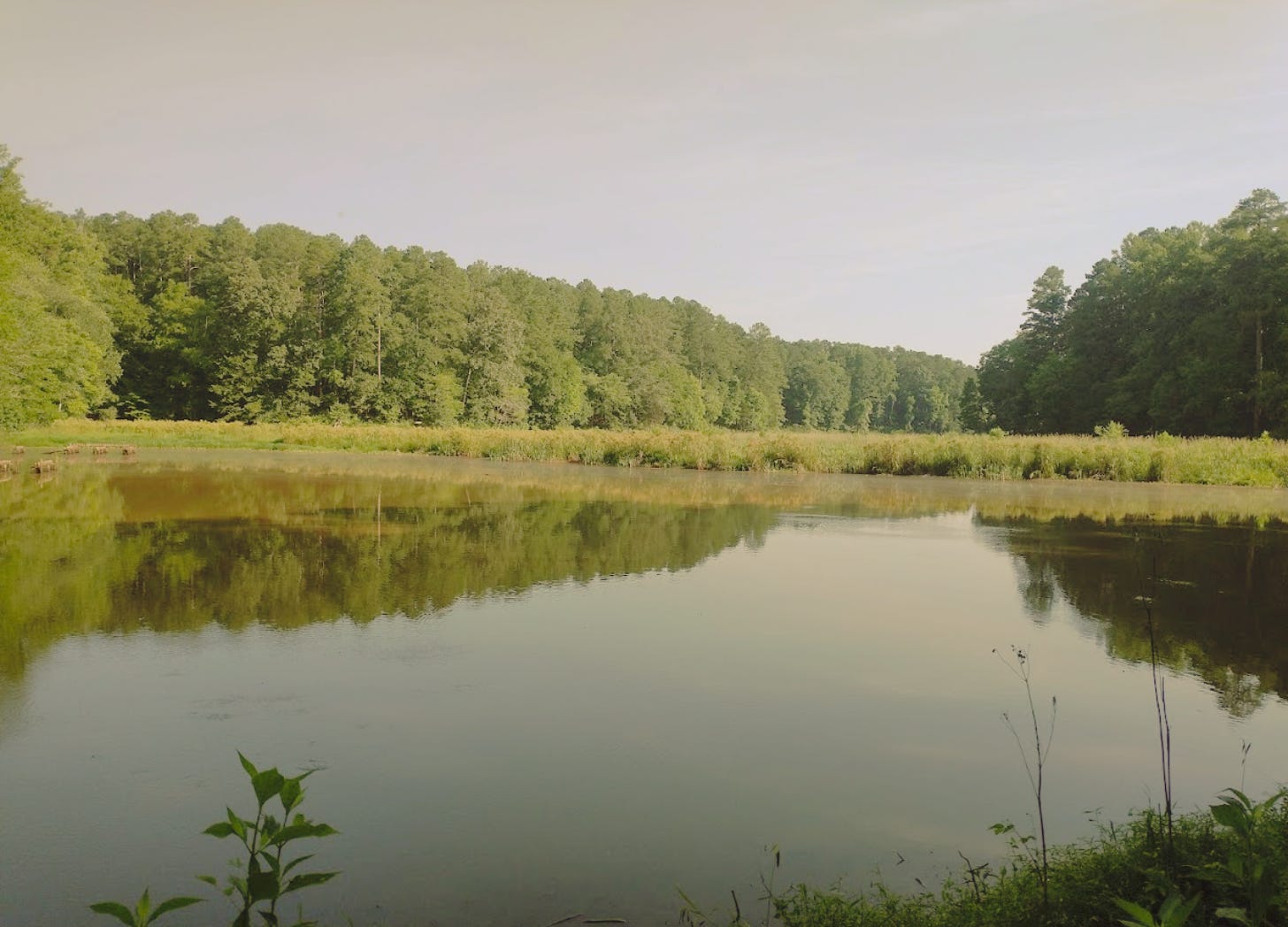
NOVA ESPERO CITY — TRIO 15, 126 PM
To those who come across this place by happenstance, it doesn’t appear to be all that significant. It could really be any urban park in our increasingly developed world — in the background, you can hear the distant Lankolay Expressway, sending commuters to and fro along the thickly settled Golden Coast. The low-slung scrubs and woody trees atop a carpet of short, beige grasses makes this space look like any other semi-natural spot in this part of the country.
But a closer look reveals an interesting story here. The hills and cliffs are less rolling and more sheer. Rather than being lined by smooth, albeit rocky, banks, the rivers and creeks slide through violent and steep gorges before dumping into the Southern Sea. The ponds are circular things gored deep into the earth, whereas virtually all the lakes in this corner of the world are manmade and far from neatly round.
At the center of this park lies the primary remnant of the circumstances of its birth. Ringed by an almost perfectly circular, sixty-foot high earthen wall, Memorial Lake is around 1,000 feet across and more than 200 feet deep. Today, joggers run its circumference atop a recently repaved multi-use path and families of ducks wade in its bright blue waters mirroring the idyllic skies above.
This scene looked very different 125 years, 3 months, and seventeen days ago. Far from being a pastoral retreat, this was the center of Hegeliopolis’ East End, a densely-populated warren of slums and shanties interrupted by the occasional factory or what could be charitably described as a sweatshop. The people here lived hardscrabble lives amid the steep inequality of that age, and the declining geopolitical order that would ultimately spell their doom.
This scene looked dramatically different still 125 years, 3 months, and sixteen days ago. On a midmorning much similar to this one – blue skies, warm weather, and a calm, gentle breeze – the slums and factories and the countless millions of lives that filled them were callously erased from existence. A significant explosive device, launched from the Ylrikian Empire, exploded some one-hundred feet above the East End, creating this crater, and incinerating the community around it. The shanties were unceremoniously atomized, and the once-smooth hills were made instantaneously craggy and bare. Fires ripped apart the few trees and makeshift parks that existed here, and a hellish inferno marched eastward in a firestorm that killed hundreds of thousands in the coming days.
In the torrential, irradiated rains that defined the subsequent weeks, soil from the denuded hills sloughed off, forming deep ravines and sharp declines. Thousands of tons of dirt containing shredded corrugated metal sheets, concrete, utility poles turned into mulch, and mountains and mountains of ash were washed out to sea.
Over time, life returned. Not human life mind you – despite the area being back to pre-war levels of background radiation within a few months, the erosion of the stigma of visiting this place would take decades. But shoots of green soon erupted from the soil. Weeds and grasses nevertheless persisted, and soon enough animal droppings brought back ferns, trees, and shrubs. Once plants took root, the erosion eased. Water filled the massive central crater, as well as the smaller ones created by the detonation of smaller SED payloads deployed by the larger missile. Wildflowers sprung up in meadows that were once neighborhoods, and small mammals made their homes in what were once sandlots and schoolyards.
Within a few years, nature had reconquered this land; in contrast to the barren, desolate landscapes that defined the descriptions of post-apocalyptic worlds in pre-war literature, this space became verdant and positively re-wilded. Conceptualizing these places as being beige, sandy, almost sterile places long after a hypothetical SED war was an odd sort of self-serving comfort. Without us, without humanity, and through tools of our creation, the world could truly end with us. Life could end with us. It would be absolutely unthinkable for it not to end with us.
Thankfully, that very human, self-obsessed view was another casualty of the War. The ducks still ruffle their feathers, the grass still grows, and the wildflowers still bloom atop the atomized remains of countless millions of mothers, fathers, sisters, and brothers.
Another prediction that proved incorrect was that society and civilization itself would cease to exist following a potential SED war. In what we now call the Milito, millions did indeed perish, and billions more from the consequent breakdown of order, famines, and disease. It’s estimated that several million died of hypothermia and frostbite alone in the frigid winters that immediately followed the War.
But much like weeds, humans and their societies tend to pop back no matter what chemicals you throw at them. Through what can only be described as a miracle, much of Hegeliopolis’ Old City was spared much of the destruction of the Milito, leaving alive thousands of residents including many well-trained bureaucrats from the old imperial ministries of agriculture and public works. These people, in concert with the impoverished residents of the Old City’s slums and the political prisoners sprung from the torture dungeon that was Fort Fortuna, were able to build some ramshackle society from the ashes of a murdered Empire.
Today, that settlement – which we now know as Nova Espero – supports a population of more than half a million people. The broader Federation, Uniguita, that spread from this peninsula is now a burgeoning democracy that contains over 25 million people. Far from the over half a billion people that lived in the old Hegelio-Ferrian Empire, but far from the 0 that the most pessimistic prophets of the post-apocalypse would have predicted. After 125 years, our cities have rebuilt, our cultures have flourished, and our technology has rebounded.
Even so, we are surrounded by persistent reminders of what we have lost – our cities are ringed by vast, undeveloped “badlands,” the remnants of dead cities not yet fully rebuilt, mausoleums containing the remains of millions of dead not instantaneously incinerated on that awful day, and so-called “SED-lakes” like Memorial, created as the result of massive explosions. Despite our modern comparative prosperity, generations of post-War collapse trauma have left deep scars on our collective psyche – the collision of modern agricultural surplus and famine-stricken societies of decades past have led to countless eating disorders. Even though no one alive today lived through the conflict and its immediate aftermath, millions still exhibit signs of post-traumatic stress disorder, and depression and anxiety are endemic. Nostalgia for the pre-War world has fueled revisionist, racist politics, and movements arguing that humanity was truly meant to perish in its totality during the Milito still spark terroristic violence today.
Despite all of this, people find ways to bring themselves joy, make it through the day, and more than just survive but thrive. Most major cities have universities that rival pre-War institutions in research output due to advances in computing and communications technology over the past century and a quarter. The Houses of Wisdom form a constellation of research institutions, pursuing knowledge with a secular religious fervor. Settlements and cities alike abound with theaters, museums, and artists’ wards, markets and restaurants where chefs and artisans experiment with old and new cuisines alike. A higher proportion of Uniguitans are literate than their pre-War counterparts, and nearly a quarter have a university education.
Poverty and inequality remain, to be sure. There are the usual deprivations that societies inflict upon themselves and call it scarcity when in reality it is unjust distribution. Not to mention the very obvious and unignorable tragedy of the extinguishing of many billions of lives as a direct result of the War, and then the subsequent billions who will never know life as a result.
Ours is a world that contrasts overbearing tragedy with unrestrainable joy, obvious loss with a subtle gain that is often unrecognizable when you are in it. The purpose of this column is to share the stories of remaining traumas and persistent dreams as well as the continuity of ancient hatreds and the flourishing of newfound unity. Just as our Federation is filled with such contrasts, so too will this column.
I will be uploading a new column each week, either continuing an ongoing story or providing a brief look into a world you may not know. You can look at the Dispatches site now to start reading A Survivor’s Story, a tragic narrative about the Tzarkowski family of survivors coming to Nova Espero just two years after the War. There is some lighter content too, such as a brief piece about ice fishing in Pierron, and the Cockroach Day celebrations in Puerto Ostra. Each of these narratives provides an inexorable part of our national story, and I hope that you find them thought-provoking, or at the very least, entertaining.
This is Mikaelo Bonavido from the Nova Espero Universalo. And welcome to Dispatches from Uniguita.