


This is the second part in a multi-part retrospective about the life and political career of former President Phillip Gladstone (43 PM - 126 PM).

UPCHURCH, NEW HEGELION – DUO 17, 126 PM
The capital of New Hegelion would be a forgettable, regional hub on the other side of the Great Inland Sea. With just under 100,000 inhabitants, Upchurch is not a great metropolitan center of a burgeoning multi-national democracy like Nova Espero, or the crown jewel in an expansive Empire like Ylrik City. Built with assistance of Ylrikia during its autocracy’s waning years as a sign of inter-regime fraternity, central Upchurch is itself a monument to authoritarian neuropathy. Its expansive and ostentatious boulevards and gratuitous monuments are relics of a different time – one where this quasi-state was not an international pariah persistently on the verge of economic collapse. Under the weight of three decades of isolation, poverty, and inept administration, the statues rot and the triumphal arches wither in the harsh northern winters.
At an oversized, over-indulgent roundabout at the city’s focal point are statues of the ethnostate’s national fathers. Lionel Upchurch, that ancient racist whose scheming, capacity for violence, and demagoguery made him a perfect avatar for the New Hegelion movement a century ago stands upright, his hand outstretched southwards as if to pull his Hegelionic co-ethnics to the north.
To his right stands Charles Belk. Even the hagiographers who design such statues could only do so much to cover up his embarrassing combover, outsized eyebrows, and awkward chin. Here, he is the same height as the historically six-foot-one Lionel Upchurch, whereas in reality he was closer to five-foot-six and 150 pounds soaking wet. At the time these statues were erected, Charles Belk was still alive – but no one dared to question the inaccuracies. Charles Belk was a god, and one to be feared. Maybe he really was six feet tall.
If things went a different way, Charles Belk would have been another in a series of Security and Justice Party also-rans, netting less than 10% of the vote in the second round of the 88 PM Uniguitan presidential election. Another embarrassing loss for an embarrassing political movement. But the 88 PM election – and the SJP’s humiliating defeat – would break something deep in the core of Charles Belk. And subsequently, something deep in the core of Uniguita.
The sum of all fears
Premier Phillip Gladstone had defeated Howard Sanck, the manifestation of the insurgent far-right within the Conservative Party. He had managed to emerge victorious without selling his political soul, but history showed that he may need to reassess. Since Carmelo’s fall in 47 PM, the Conservatives had been unable to capture a general election victory without the support of their in-house right wing, in addition to the support of the Security and Justice Party.
And the leader of the SJP, Charles Belk, was an obstinate extremist. Emerging from the ideological backwater of the extreme wing of an already extreme party, Belk was never going to settle for anything less than the traditional “Agreement” between the Conservatives and the SJP. In exchange for their support, the SJP would seek diminished federal involvement in New Hegelion’s internal affairs, and relaxed enforcement of the Federation’s constitutional civil rights guarantees. This had been the quid pro quo for the past half century, from Carmelo to Pelar to now. No Conservative presidency, no conservative majority in the Council could be formed without acquiescing to these demands. And after twenty years of isolation from political power, Belk figured that Gladstone and the Conservatives would be more willing than ever to make concessions.
But Phillip Gladstone had a different read of the political landscape in 88 PM. From his point of view, it wasn’t the Conservatives who were fatigued from loss, but the Uniguitan people from two decades of Populist victory. Since Conservative Fernando Pelar left office twenty years before, the People’s Party had had a stranglehold on federal power. The 86 PM midterms had offered a glimmer of hope – the Conservatives and SJP were able to capture a workable majority. A slim majority, but a majority nonetheless. Since those elections, people’s views of the Poppies had soured even more – the incumbent president Stephen McAllister had an approval rating of just 30% by mid 88 PM. His anointed successor, Vice President Harry Pierce, sat comfortably in the mid-30s in the first round polls and had only just barely won his own party’s primary. Gladstone didn’t think he could win in the first round – a Conservative had never won outright in the first round – but he thought he could win in the second round with less support from the SJP.
Over the next three months, Gladstone toured the country, courting the countless ethnic organizations and special interest groups in the Conservative constellation. He spoke at assemblies of traditionalist Fosterians, meetings of Swalabash swampmen’s unions, and the soirees of suburban ladies’ clubs. He swept to the right sometimes – “it’s clear that the Poppies are incapable of ensuring that law and order are maintained,” he told an audience in Vetludo. “It’s high time that we start laying down the law, and follow Commissioner Renzi’s example.”
Arturo Renzi had been the controversial chief of police in Vetludo, a city long-known for its violent organized crime. After becoming the city’s top cop in 79 PM, Renzi pursued a tough-on-crime agenda that bolstered his popularity on the national stage. While he was applauded for taking down a number of criminal outfits, his heavy-handed methods came under fire for violating citizens’ civil rights, and his police bureau faced allegations of torture and extrajudicial killing. “If you have a problem with lower crime, safer streets, and fewer gangsters running around, you’re free to leave,” Renzi once told reporters. When questioned about the suspicious death of a suspected gang member, he shot back, “how many crooks have you put away?”
There was a line that Gladstone wouldn’t cross, at least not explicitly – he would not voice his support for continuing “the Agreement.” He didn’t outright condemn it. But in speeches across the country, he hesitated to race-bait or champion “local rights” in the way that SJP audiences might have liked. He instead focused on kitchen table issues like public safety, the economy, and government corruption. The Poppies had given him plenty of ammunition – President McAllister’s chief of staff had just been convicted of surreptitiously taking a bribe from an automotive manufacturer seeking rollbacks in regulations – and he intended to use it.
That someone like Renzi, who should have been an easy target for SJP support, threw his heavyweight law-and-order endorsement behind Gladstone should have been a warning sign for Belk. In prior years, the SJP had cleaned up with the tough-on-crime crowd. If for nothing else, people voted SJP to send a message to the Conservatives: crack skulls, or get out of the way for people who will.
But the SJP had spent the past decade and a half whittling away its own support. In the past two decades, the SJP had become more single-mindedly obsessed with New Hegelion-specific issues, and the majority within the party’s governing institutions had become increasingly isolated in the echo chambers of the Hegelionic ethnonationalism that had come to dominate the northern political zeitgeist. Old Hegelion, once a bastion of support for the New Hegelion project, had politically moderated in recent decades. The SJP was quickly losing support there, and it became a vicious cycle – as more southerners left the party, the radical northerners gained power. And as they gained more power, the party became more extreme and alienated more southerners. When Fernando Pelar left office in 68 PM, around a third of SJP Common Councilors came from the south. By 88 PM, less than a tenth did. In 72 PM, the SJP won 23% of the vote in the first round of the presidential election. In 84 PM, they won just 12%.
On Election Day, the cumulative effects of Gladstone’s vigorous campaign and the SJP’s decline revealed themselves. Belk won a record low 8.3% of the vote, and his SJP won around the same amount in the party list vote. But much to Belk and the SJP’s terror, Gladstone won 50.7% in the first round. For the first time, a Conservative who made no effort to reach out to the SJP and had very little interest in their prerogatives had won a majority of the vote in the first round. He had secured the presidency without making the formulaic appearance before a convention of Security and Justice Party members, or prostrating himself before audiences of skeptical Upchurch racists.
Belk and his strategists held out hope for some sort of continuation of the Agreement through the Council. The Conservatives hadn’t won an outright majority in the legislature, and dozens of district races where no candidate won more than 50% of the vote in the first round would go to a second round of voting. In a number of swing districts, the SJP attempted to covertly support the Populist candidate in the hopes of denying the Conservatives a majority and forcing them to coalesce with the SJP. Just days before the second round of voting was to take place, the Universalo revealed the scheme in a front-page exposé.
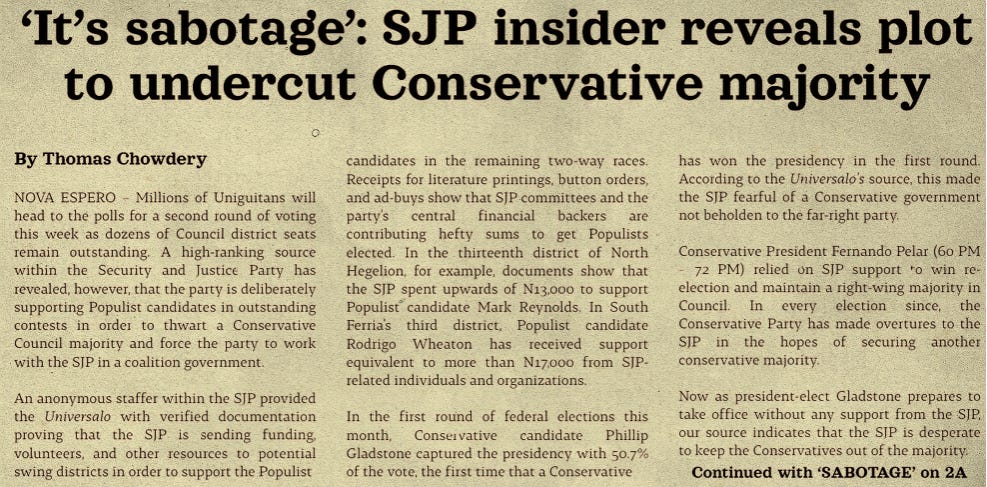
The following day, Gladstone and the Council Conservative leader Paula Laredo announced that, even if the Conservatives failed to gain a majority, they wouldn’t work with the SJP.
“This isn’t just political hardball, this is cynicism,” Gladstone told a gaggle of reporters. “After the past two decades of corruption and mismanagement, there will be no room in the upcoming government for cynicism. We need pragmatists and idealists, not the tacticians of dirty backroom politics.”
On the day of the second round, the sum of all Belk’s and the SJP’s fears had come to fruition. The SJP’s efforts at political subterfuge had failed – the Conservatives would have their first outright majority in Council since the Carmelo administration forty years prior, with several votes to spare in case a few members needed to buck the party line.
The Conservatives had won. And for the first time, the SJP wasn’t along for the ride. The SJP had learned that they were not indispensable to a Conservative victory. Gladstone didn’t need them. The Conservatives didn’t need them. In fact, they didn’t even want them.
Belk still held out hope for some semblance of right-wing allyship between the two parties. Gladstone made great haste in dashing it.
A world on the precipice
When Phillip Gladstone took office on Dekaduo 1, 88 PM, supplicating the northern racists was not at the front of his mind. The economy was in freefall, and confidence in the government had been shaken by a series of corruption and moral scandals within the preceding McAllister administration. Long-standing ethnic grievances between the Zoldish and Pravish peoples had escalated into reciprocal spasms of violence, and the nation’s institutions were under stress from incoming waves of refugees fleeing Ylrikia’s renewed repression in the Central Mountains and the Crescent Islands. Simmering tensions with an increasingly revanchist Ylrikia stoked fears of renewed continental war, and some analysts hypothesized that the Empire was on the verge of redeveloping the same bombs that had nearly snuffed out humanity less than a century before.
From his new office at Voorhees Square, President Gladstone saw a world on the precipice. Growing anxieties over political and cultural irrelevance in the north weren’t the most salient issues, and responses would be delegated to advisors. “In the context of everything, it didn’t seem like that big of a deal,” Gladstone told the Universalo in 112 PM.
For Charles Belk, the issue was front of mind. Despite all of his efforts, the Conservatives no longer had to seek his party’s advice or support on anything. Rumors spread that Gladstone would be pushing for a general amnesty for illegal immigrants. With the SJP-written Immigration and Naturalization Act of 64 PM nearing its expiration, theories suggested that the Conservative government would create an immigration framework that was more relaxed. The 64 PM act contained a carve-out that essentially allowed the commonwealths of New Hegelion to determine their own linguistic and immigration policies. A draft of the new replacement legislation crafted by the Conservative majority had no such carve-out, and in fact would mandate that New Hegelion absorb more immigrants and refugees.
On Duo 18, 89 PM, the Security and Justice Party held its regularly scheduled post-election conference. There, the party faithful reviewed the previous year’s results, and determined whether or not to retain the leadership. Charles Belk, still the leader of the SJP in the Common Council despite his loss in the presidential election, faced an uphill battle to keep his spot. The SJP had lost seats despite the deep unpopularity of the People’s Party. The party now only had a handful of remaining councilors south of the Inland Sea. And some viewed Belk with contempt; the party’s more aristocratic sort saw his scheme to block the Conservative majority as being vulgar and underhanded.
When Charles Belk approached the podium at the conference’s opening session, he was greeted with applause. From the aristocrats came tepid claps, the mandatory show of praise to demonstrate continued party unity. From Belk’s allies, the stubborn support of a village welcoming back its fallen wrestler from a bout in a neighboring town. “That kid was a gorilla, it wasn’t your fault,” some would say, patting him on the shoulder. “You gave ‘em a good fight.”
It isn’t known when Belk decided to make the speech he ended up giving. It matched no written remarks found anywhere, least of all the ones that he laid down on the podium.
“Fellow patriots,” he began. “I come to you today as the leader of our Party. Before all else, I take responsibility for our performance in the most recent election. As the leader, the buck stops with me.”
The energy in the convention hall was restless. Delegates milled about. Some shared words about the upcoming leadership votes. Others sat in silence, listening to what was expected to be Belk’s final words from the political gallows.
“Before I offer you my resignation, I ask that you humor me, and allow me to share with you a story.”
Belk proceeded to tell a romantic tale of New Hegelion – as a nation of exiled Hegelions, the progenitors of Uniguitan governance who were eventually shunned for their culture and their adherence to traditional moral principles. He told of how the Uniguitans came to embrace these expats, seeing their wonderful cities, thriving industry, and solid faith. But over time, the love affair soured. The old bigotries returned.
“They loved us for our faith, and then hated us for our adherence to the word of God,” he said. “They loved us for our care of history, and then hated us for strenuously defending our way of life.”
He argued that, in this new age, the Populists and Conservatives had molded into one. “They value indulgence over integrity, profit over prayer, and hedonism over heritage,” he told the audience, the tenor in his voice rising.
“The election was rigged,” he yelled into the microphone.
“Not at the ballot box, no. They didn’t need to do that. It was rigged by a media that peddled pornography and loose morals. It was rigged by an academia that tells children to hate their history. It was rigged by a culture of decadence, of vanity, of gluttony,” he howled.
“The system our forefathers fought so hard to build has become rigged against us,” Belk clamored, as the volume picked up in the conference hall. “And I pledge, as your leader, to resist that wicked system to my dying breath.”
The crowd jumped to their feet. Belk had lit a fire at what was supposed to be his political funeral. Even the aristocrats, the executioners ready to spring the trapdoor and usher in a new era for the SJP, couldn’t help but cheer. The noose around Belk’s neck quickly unraveled.
“My friends: for so long the south has waged war against us,” he concluded.
“Now, together, we will take the war to Nova Espero!”
There was rapturous applause in the chamber. Most in the hall understood this to be a rhetorical war, a culture war against an increasingly immoral and misguided south. But some heard something else. Something more profound.
Some saw Belk’s address as the opening salvo in a revolution.