


This is the third part in a multi-part retrospective on the life and political career of former President Phillip Gladstone (43 PM - 126 PM).
NOVA ESPERO CITY - NAU 24, 126 PM
“Hello, good morning everyone,” began the Chief of the Federal Common Council Lincoln Reynolds at a press conference on Kvarto 6, 89 PM. “For two decades – two decades – we have seen what unaccountability in government gets us. It gets us corruption. It gets us runaway spending. It gets us mid-level bureaucrats earning three times the average wage, and projects going two, three, four times over budget.”
Chief Reynolds, an East Hegelion like the new president, was a government spending and corruption hawk. With some of the funding that the Conservative government was set to save by cancelling what he called “frivolous projects,” he wanted to embark on a new effort that would ostensibly open up the doors to government for all to see.
“In the war on corruption, we are announcing a new superweapon – the Federal Affairs Television Network.” Reynolds explained that this service would broadcast all meetings of the Common Council as well as public briefings from the executive and judiciary. Eventually launching on Unuo 1, 90 PM, the content would prove dry. Compared to the carefully curated dramatic speeches and confrontations during Council testimonies that had been beamed to television screens on ratings-driven news programs for decades, FATVN’s hourslong broadcasts of committee hearings and roll calls was far from riveting.
Even so, one man made the best of a network whose viewership otherwise would have consisted solely of bored journalists and policy wonks: Charles Belk.
New Hegelion news stations, most of which were aligned with Belk’s far-right Security and Justice Party, did not have the funding or resources to set up cameras to record sessions of Council. They often had to pay other news services for their footage, which rarely portrayed SJP councilors in the most favorable light. Not that those councilors helped themselves very much – they were prone to misinformed and polarizing outbursts. But the northern news services found it hard to edit the footage into anything usable.
Now, however, a federally-funded, nationally broadcast station would be recording all sessions, for free. Even sessions where the Council was open, but no votes were taking place. Councilors previously used these sessions as an opportunity to enter items into the Council Record, if for nothing else than to be able to tell their constituents that they had brought that particular topic up in session. These sessions – on Quartago1 at eight in the evening – could prove to be a primetime opportunity for a savvy propagandist.
Every week, without fail, Charles Belk signed up to speak during these sessions. He made sure to go to the Council clerk’s office first thing at the beginning of the week when signups opened so that he would be the first to speak. The northern news stations began assigning that timeslot to the Council session, where Belk would appear at precisely 8:05 (to allow the folks at home to be a little late themselves) to issue his latest diatribe to the hometown crowd, live and in color.
His topics of discussion were varied. One night, he might criticize the incumbent government’s budget, or the Department of Education’s new policy on school lunches, or the appointment of some judge or another. Regardless of the matter at hand, Belk could contort any topic as a confrontation between the godless, cosmopolitan South and the God-fearing, earnest North. In the past, Belk and his fellow SJP members portrayed their struggle as being against (typically) metropolitan Populists and urban Liberals. Now, Belk made the Conservatives, the “squishes in the fight against civilizational chaos,” as he once called them, the enemy.
“Once again, President Gladstone and the so-called ‘conservatives’ have betrayed their name and their country,” Belk said in the Sexto 13, 90 PM edition of his weekly address. “They say that they ‘conserve,’ that they respect the morals and traditions of our nation. And yet time and time again, as people of this ennobled and effete class usually do, they are yielding in the face of an atheistic and communalist mob.”
The focus of this particular diatribe was N5,3002 in funding for murals in Uniguitan primary schools. The murals, according to the funding statement, were “to depict scenes of the Federation’s beautiful and varied natural landscapes.” Belk saw the funding as not only overindulgent, but also portrayed the emphasis on natural settings as, “acquiescence to environmentalist radicals,” and that Federal funding should be used to “glorify [the] nation’s past, and honor its heritage,” rather than “trees, bugs, and rocks.”
The southern press lampooned Belk and his fellow SJP members as being fringe, increasingly politically irrelevant caricatures of northern conservatism. But in the north, Belk’s tirades were must-see TV and a manifestation of the region’s already-existing resentment towards the urbane south, progressive or conservative.
Soon, Belk would have ammunition to whip his constituents into a frenzy.
The Immigration Act of 91 PM
Back in 66 PM, the Conservatives and SJP in Council and Conservative President Fernando Pelar had achieved one of their coalition’s most significant accomplishments. For years, immigration had been a consistently animating force on the Uniguitan right; President Enrico Carmelo first gained national prominence in the mid 30s for venomously attacking immigrants in the name of protecting domestic labor. In 37 PM, he helped instigate the Trio Days, wherein members of the predominantly-Western Shipbuilders Union marched through Ylrikian and Crescent Islander neighborhoods in Port Williams, where they intimidated residents and instigated racial violence.
These events reflected a broader cultural animus against immigrants in Uniguitan society. Despite the deaths of over a half a dozen people and destruction of millions of notes worth of property, Carmelo and his fellow conservatives polling numbers increased following the riots. Throughout his presidency, Carmelo relied on the support of conservative-inclined blue collar workers who feared the effects of immigration on their wages and the changes in local culture that arose from their arrival. In 41 PM, Carmelo’s government passed the first of the Immigration Acts, which imposed draconian punishments for illegally migrating to the Federation and strict quotas on annual immigration. When the Populists took over in 48 PM, they changed very little about this immigration regime, fearful of rocking the boat on such a sensitive topic amidst their attempts to reform the federal system throughout the 50s.
In 66 PM, President Pelar signed into law a continuation of the first Immigration Act, with some additional restrictions meant to benefit the more racially conservative northern commonwealths. Individual commonwealths would be able to set their own unique immigration policies that could be stricter in the name of “maintaining existing cultural and demographic cohesion.” Prospective immigrants to New Hegelion would need to receive approval from New Hegelion authorities before arrival. Given the commonwealth’s view on immigration, this effectively meant that no new immigrants would need to be approved. In the eyes of the anti-immigration radicals within the SJP, this was a massive victory.
By the early 90s, the effects of this policy were evident. Even under a tightly controlled immigration environment nationwide, the percentage of “foreign-born” residents/citizens in New Hegelion was far lower than in other parts of the country. There were some years where no immigrants were admitted to New Hegelion, or only a handful would be for the completion of specialized engineering tasks in the commonwealth’s extraction industries far in the backcountry. Even then, such numbers rarely exceeded the double digits.
The early 90s also marked a markedly different context from the 60s, however. As Ylrikia liberalized in the 60s and 70s and the economic situation there improved, immigration pressure from the East dramatically reduced. Accelerated economic activity increased competition, but it also increased demand for Uniguitan manufactured goods, high-technology, natural resources, and services such as finance, banking, and the arts. Despite the steep recession in the late 80s, the period between the 60s and the 90s was generally one of widespread economic advancement. Emerging from the recession with force by late 89 PM, Uniguita in 91 PM found itself in a labor shortage. At the same time, the People’s and Liberal parties’ bases had become more progressive with regards to immigration reform, as had the increasingly business-minded Conservatives.
With that context, and relying not at all on the SJP for political support, the Conservative government presented a massive overhaul in its Immigration Act of 91 PM. Existing quotas would be relaxed or outright abolished. The immigration process itself, which previously required immigrants to remain in Uniguita for upwards of twenty years prior to naturalization, was to be dramatically simplified and streamlined. And, importantly, the commonwealth clearinghouse system for New Hegelion would be eliminated.
Belk and his fellow northern SJP members were outraged. On FATVN, he lambasted the act as “government-sponsored genocide,” saying that, “soon our schools and cities will be overrun with the children of other nations, all scrambling to scavenge off our remains.” New Hegelion premier George Baxley called the act “cultural poison,” and promised to “resist, by force if necessary, any attempt to settle unvetted individuals on our sovereign soil.” Some members of the commonwealth’s Common Council called for secession. Member Lyle Wright called the Immigration Act, “an act of war,” and said that, “sometimes, wars need fighting.”
Regardless, the act overwhelmingly passed without the support of a single member of the SJP. A hail mary case against the act, quixotically on civil rights grounds, initially succeeded at the hands of a sympathetic northern federal district court judge, but ultimately failed in the Constitutional Court.
As a final defense, Belk, Baxley, and their allies hoped that the well-known antipathy of the region’s residents towards outsiders would dissuade immigrants from coming north.
Far North Logging
New Hegelion was not immune from the economic pressures experienced by the rest of the country. The local economy, heavily reliant on resource-dependent industries like logging, fishing, and mineral extraction had been lagging behind the national economy. Many of New Hegelion’s young people, facing little prospects but timbering and fishing, fled to the more cosmopolitan and diversified job centers in the south. This sloughing of the region’s young people, in addition to the growing economy elsewhere, produced some increased demand for the north’s products, especially wood for home construction.
Finding little in the way of available local talent, the Far North Logging Company reached out to federal immigration authorities to facilitate immigration to the region. The Immigration Act offered expedited citizenship for those who were willing to work in “in-demand fields,” and northern timbering was far from being out of demand. Federal authorities arranged for 107 individuals – workers, their spouses, and their children – to arrive in New Hegelion.
The move was initially kept under wraps by the federal government, fearing hostility from northern officials and residents. In early Trio 91, however, Belk discovered the proposed move and vehemently opposed it in his weekly speech home.
“The federal government – without our consent – is forcing these untested, sick, and deprived people upon New Hegelion,” he said in his Trio 7 speech. “We will have to care for them, take them on as wards of our state, and we cannot even be assured that they will be intelligible to us. Do they speak our language? Will they honor our customs? It is doubtful that they will.”
This was shaping up to be a normal, if angrier than normal, speech by Charles Belk. But towards the end of the address, he became more existential.
“The south has been firing upon us for years, and this is yet another barrage against us in their continuing war of iniquity. I am calling on all good people in the north – in government or out – to resist by all means necessary this unconstitutional act of aggression on New Hegelion.”
Few but those in New Hegelion were watching these remarks. Within days, Belk had received tens of thousands of letters of support from his northern neighbors. “Give ‘em hell in Nova Espero, Chuck,” one said. “And we’ll give ‘em hell here.” “We’ll hang them from the lightposts if we have to,” said another.
Through his connections, Belk sent details of the immigrant movement back to Upchurch. Premier Baxley called up the commonwealth militia, ordering them to be on high alert. The Knights of St. Foster, a long-existing, far-right organization that had deep roots in the region, organized a citizen blockade at Upchurch’s port when the immigrants arrived.
Meanwhile, President Gladstone faced a choice: have the immigrants make their journey into a hostile region, or to back down.
‘God damn them’
Despite the upcoming onset of spring, the air was still crisp in the afternoon on Trio 15 when President Phillip Gladstone’s plane touched down in Pierron. Gladstone had always enjoyed these days most, when the skies were cool and clear, and it was as if the air was the cleanest it could possibly be. Each breath felt more refreshing than one taken in the heat of summer or the stifling cold of winter.
Sporting a thick, dark coat, the president walked down the stairs from the aircraft, greeting reporters as he stepped onto the tarmac.
“Good afternoon, everyone. Lovely day, isn’t it?”
“Mr. President, have you made a decision on the Troubador yet?”
“No comment, Beck, you know that,” he told Rebecca Carlisle of the Universalo with an uneasy smile. He continued on to his car as a flurry of questions followed him. Later that week he told them that he had been resolute in his decision to send out the ship from the time the request had come to his desk weeks earlier. In the following years, however, his story changed. “Truthfully,” he told the Universalo in 112 PM, “I didn’t make up my mind until right before I stepped up to the podium later that night.”
The president was facing conflicting advice. Some advised that sending these 107 people to New Hegelion was a disaster waiting to happen. Others told him that to allow the north to openly flout the law was an irreconcilable error. Gladstone had indeed pre-emptively approved the shipment a month prior, but was beginning to have second thoughts. He received intelligence reports of informal militias setting up sniping roosts along the roadway leading to the region’s interior, and others of the more official commonwealth militia drumming up martial, existentialist rhetoric among their ranks. On TV every night, Belk and Baxley tag-teamed on calling the shipment of migrants, “a crime against not only the Constitution to which we agreed, but to nature itself.”
In the mid-afternoon, he met with the migrants who had agreed to go north. “They were a truly remarkable group of people, unparalleled in bravery I have to say,” Gladstone said in the 112 PM interview. Most had plentiful experience in timbering and forestry in the Central Mountains before increased Ylrikian repression in the region and economic decline had forced them out.
Shortly after meeting with the migrants, Gladstone held another private session with his closest advisors. After a brief discussion, he sat down alone with his wife, Anna. Gladstone told her of his bitter memories as premier, how he felt about the Clarendons, the Lacaise couple who had faced discrimination in East Hegelion and whom he had failed to properly protect. The two came to the conclusion that honoring these peoples’ civil rights was a necessity, but Gladstone demurred on whether or not it was in their best interest to send them onto hostile ground.
After some conversation and debate, the two came to a final conclusion. Of Belk and Baxley, Gladstone’s parting words were simple.
“God damn them,” he told Anna as he walked outside to a waiting press conference.
“My friends and neighbors,” Gladstone opened to the flash of cameras and the hushed group of reporters assembled.
“In the past few hours I have had conversations with some of the most courageous and outstanding people I have ever met in my life. These are people who traveled thousands of miles, many by foot, because they believe that they could find a better life here than back wherever they came from,” he continued.
“They knew what they would face. A language barrier. Cultural shock. Communities that could be less than patient, less than kind, less than hospitable. And yet, they came here anyway. They came with their families, their children, in the hopes that they would prosper better here under sunnier skies and under the aegis of freedom.” He cleared his throat. He described how they were bringing invaluable expertise and ingenuity to the region, and that their contributions would far outstrip any inconvenience or discomfort brought about by their arrival. He told the story of one migrant who had left his home village behind because the corrupt constabulary had repeatedly arrested him for not paying exorbitant “protection” fees. He told of another who hoped that her daughter would one day attend university.
“These people, with their hopes and dreams and aspirations are cut from the same cloth as each of us that call ourselves Uniguitan,” he said.
“And tomorrow, we will be sending them to New Hegelion to do what it is they want to do: work, prosper, and be a part of our community. When I ran for the presidency in 88, I did so with the idea that no individual should be above the law. I am throwing down the gauntlet here today, and saying that no commonwealth and no party is above the law. Thank you.”
He quickly left the podium, leaving behind a chorus of shouted questions and camera flashes.
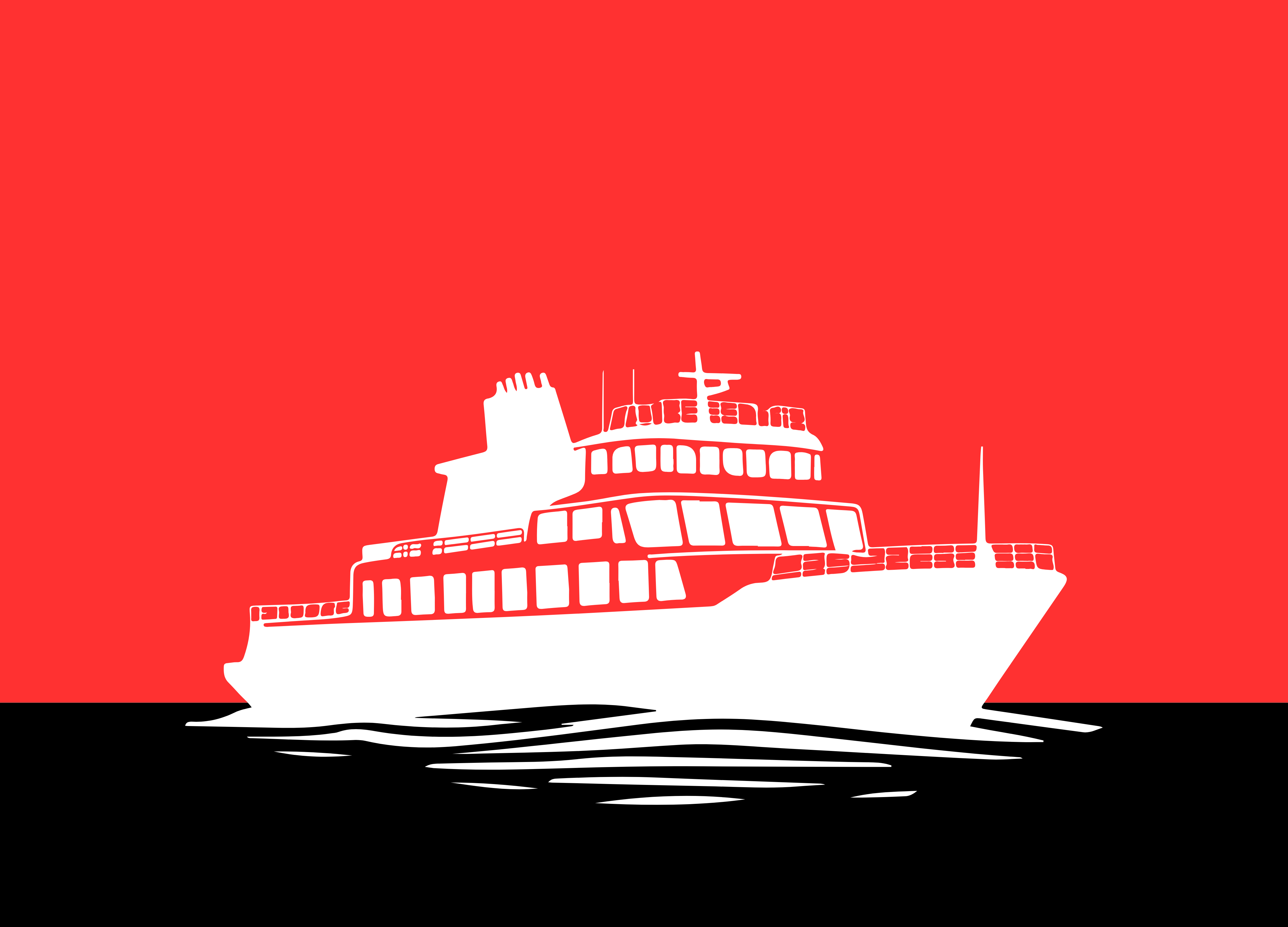
Shortly before seven o’clock, Gladstone bid the migrants farewell as they boarded the Troubador, a large ferry that had been pressed into service for their transport. At 7:00 sharp, the crowds waved them on as the migrants – and their accompaniment of twenty armed members of the federal Gendarmerie – left the shores of Pierron behind. In a little under twelve hours, they would be at the docks of Upchurch.
In New Hegelion, meanwhile, protestors burned Gladstone in effigy and Premier Baxley said in a rally that, “under no uncertain terms will those people be allowed on our soil.” Among the crowds, members of the Knights of St. Foster spoke in hushed tones of secession. Bolder ones shouted into the wind. Red and white saltires waved vigorously amid curses of the south, of Gladstone, and increasingly, of the Federation itself.
The Troubador
The Troubador’s pilot, Adam Wilkes, remarked of the unseasonably calm waters of the Great Inland Sea the night between Trio 15 and 16. “At that time of year, the waning gales of the winter are usually still churning the waves,” the twenty-year veteran of the notoriously turbulent waters said days later. “But it was calm. Dead calm. It was as though our wake was shattering a massive plate of glass.”
As dawn approached on Trio 16, the Troubador approached the docks of Upchurch. Waiting were a handful of requisitioned buses and a complement of armed Gendarmes. Above them, however, were dozens of white-helmeted members of the New Hegelion Commonwealth Militia looking over the slip. Behind them were thousands of New Hegelion residents, still agitated from the night before and increasingly so from a procession of radical speakers in the chilled, late winter air.
Charles Belk, who had arrived early that morning, served as the headliner. He said that Trio 16 would mark a, “hinge in our national history, a great inflection point that will determine whether we are a sovereign people, or a subordinate people.”
“When that ship loaded with vermin and pestilence nears our shore there is no alternative. We must resist, resist, resist!” he barked into a microphone to the cheers of the crowd assembled.
On the slip, the Gendarmes waited anxiously. Outnumbered considerably by the militia and the crowd, they hoped that the threat of force from their equipment and federal prestige would dissuade any troublemakers. That today would be tense, but that Belk and his allies would make their stand, state their objections, and carry this as another act of resistance to color their pamphlets during the next election cycle.
There had been limited chatter of active resistance, but so far it seemed to the security officers that a passive stand was more likely. “There was no attempt by the Militia to block roadways leading away from the waterfront, and the officers positioned at constructed barricades encountered nothing but insults and cantankerous crowds,” wrote Gendarme Raoul Tremblay in an after-action report.
When the Troubador appeared on the horizon, there were shouts and jeers from the crowds. As it grew nearer, the protestors threw bottles, bricks, and rocks at it. The gendarmes aboard noticed, but anxieties were subdued. “They fell harmlessly into the water, several yards in front of the vessel,” wrote another Gendarme, Suzanne Poulin, in their after-action report. “The distance was such that we were not entirely confident they even intended to hit the vessel, rather than just voice their frustration. No one came close to actually striking Troubador.”
The jeers became a cacophony as the ferry’s gangway lowered. Gendarmes in black suits with carbines disembarked first, escorting the migrants off. Most hurried over the buses, but one, the narrow-shouldered and lanky forestry supervisor Jerrald Takashi deliberately smiled and waved at the protestors as he alighted.
“I am not an angry or fearful man. That is not in my character,” he later said. “When I bare my teeth, they are not sharp, and at the end of my fingers there are no claws.”
Roughly half of the migrants had moved over to the arrayed buses. The harangues were boisterous, but nonviolent. Poulin remarked that no bricks fell upon the migrants, despite the migrants being well within the range of the protestors.
Then, suddenly, a gunshot. Or a vehicle backfiring. Or something falling onto the concrete at a nearby pier. Subsequent investigations came to no satisfying conclusions. But what is known is that fear permeated both through the New Hegelions, and the gendarmes.
Then, what was indisputably a gunshot. From which side, again, no satisfying conclusion. But what followed was screaming from both sides punctuated by the crackle of gunfire.
Pandemonium.
[OOC: Thursday]
[OOC: $123,131 in 2026 US dollars.]