


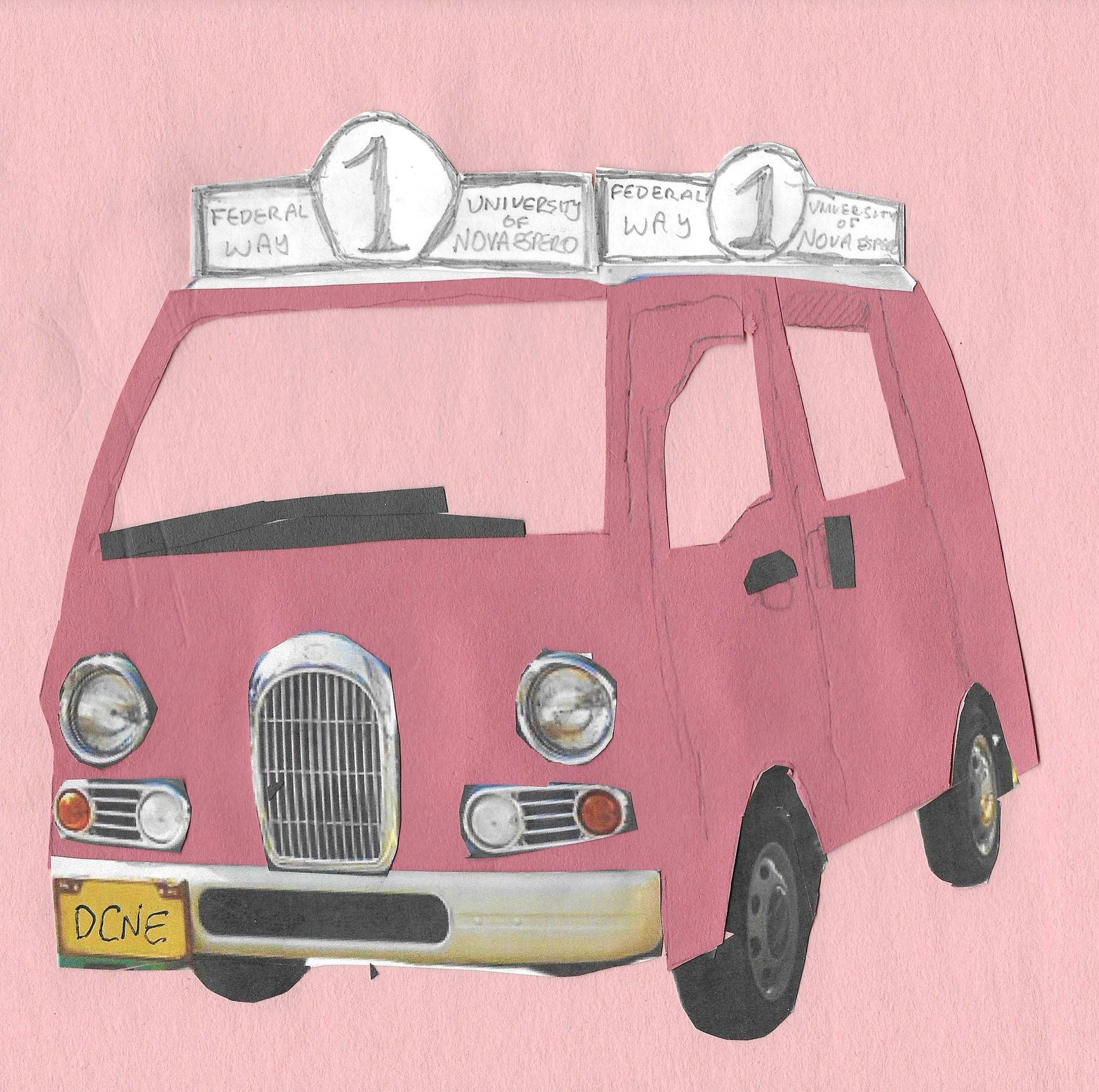
NOVA ESPERO CITY - KVARTO 5, 126 PM
For deuce-driver Robert MacThomas, the day begins at 5 o’clock in the morning. He starts in his Southern Ward apartment which he shares with his wife Moira and his two sons. After a brief cup of coffee and hastily prepared toast, he is out the door before the rest of his family is even awake.
He then bikes over to the Southern Ward station of the Drivers’ Cooperative of Nova Espero (DCNE – typically read aloud as dickney). He badges in through the chainlink gate, alongside several other drivers. They each go to the DCNE office where they pick up their routes and route placards. These placards tell pedestrians where the vehicle attached can and cannot go, and in which zones the driver can pick up passengers.
“Zone 1, lucky pull,” Robert tells me as he receives his placards. Zone 1 contains the northern half of the Federal Way, a highly trafficked corridor of shops, museums, government offices, hotels, and a variety of tourist destinations. “People tip like profligates when they’re on vacation,” he tells me in his delightful rural Kilmartin brogue.
After he gets the placards, I follow Robert to his deuce, a brightly painted van with a carrying capacity of six – “seven if they’re skinny,” he tells me with a grin. He slides the placards into the wrought iron display atop the roof, showing potential clients that he is an officially licensed, DCNE-endorsed driver. Robert then performs a series of pre-trip checks – tire pressure, lights, windshield wipers. There’s nothing to flag today, but he assures me that when there is an issue the mechanics the Cooperative keeps on hand are quick and reliable.
He then unplugs the vehicle from its charger, and steps into the driver’s seat (on the right side of the vehicle, rather than the left) while I take the passenger side. We crawl out to the station exit behind a dozen or so other vehicles waiting patiently to turn onto Southern Avenue.
At 6:00 sharp, deuce #815 leaves the station and is ready to start the day.
What is a deuce?
“It’s an awful name, now, given the euphemism,” Robert delicately tries to explain. More professor than cabbie in dress and temperament, the fifteen-year veteran of the trade seems to still lament the name of the primary tool of his profession.
Deuces – the ubiquitous share-taxis of Nova Espero – first hit the roads in the early 10s. The scarcity of automobiles and the non-existence of real public transportation meant that alternatives were necessary for workers commuting across the increasingly sprawling settlement.
“There was no subway, there were no trolleys, there were no buses, and there absolutely were no private cars,” my driver for the day tells me. “You either walked places or, if you were lucky, you biked there.”
Francois Gauthier and his brother Simon had been road-tripping across the Empire when the War hit. When they arrived in Nova Espero in 2 PM, their worn-out, four-door, six-seat 1759 O.S.1 Richardson Trekker was their only possession. The van proved a valuable commodity in an automotive-starved Collapse-era Nova Espero, and the Gauthiers started a scavenging business where they used the vehicle to haul heavyweight materials back from the wasteland.
As time wore on, however, Nova Espero acquired and refurbished more abandoned trucks that were better suited to the task of salvaging. The Gauthiers, ever the entrepreneurial type, found another use for their van. As the city spread outward and distances became more difficult to navigate on foot, the duo began running a shuttle service between worksites and residential areas. The fare cost two pennies at first, or deux in the Gauthiers’ native Lacaise. This deux became deuce, the name for the vehicles themselves.
The business was so lucrative that the Gauthier brothers looked into buying more vans to expand their operation. Being a pricey and diminishing commodity as a result of a moribund, post-War auto industry, the brothers found difficulty in purchasing more vans on their own. So, they joined with a few other potential investors who would serve as drivers, part-time mechanics, and shareholders in the enterprise and formed the Drivers’ Cooperative of Nova Espero.
By the end of the decade, ten deuces trawled the streets of Nova Espero, picking up workers and shoppers throughout the city. They lined up outside worker housing at the beginning of the day, and then at the factory gates at shift changes. In an age where automobiles cost ten times the annual salary of a resident of the city, the deuces provided a vital piece of semi-public transportation infrastructure.
DCNE solidifies
By the 30s, the auto industry had finally begun to recover. Though they were still inaccessible to average commuters, automobiles did become more accessible to independent deuce operators, so-called indies. The Cooperative prided itself on its safety record, the training of its drivers, and its fair, consistent rates, and saw the newcomers as vulgar imposters. Their fares were often lower, sure, but their vans were poorly-maintained, their drivers dangerously inexperienced, and their service was subpar. Accidents were commonplace, and one 39 PM study from the City found that independent drivers were more than twice as likely to strike a pedestrian than DCNE drivers, and passengers were five times as likely to be injured in an indie than a DCNE deuce.
As independent drivers’ reputation diminished, they began to imitate Cooperative drivers. They placed DCNE logos on their vehicles and their uniforms were purposely designed to resemble DCNE’s. Frustrated by this mimicry, the Cooperative looked for ways to differentiate themselves from the indies in a new way.
Among the various wholesale markets that were still brimming with the reclaimed refuse from cities shattered by the War, then-driver for DCNE Carlos Primavera noticed something strange. Just before the War, a hotel in Nova Espero had purchased dozens of distinctive bedframes made of wrought-iron. Though many buyers at the market would snap these up for their own homes, Primavera had a different idea. He saw an opportunity when he noticed that the twin-sized headboards were roughly the width of most DCNE vans while the king-sized frames were roughly the vans’ length.
Primavera made the snap decision to buy a set, and went back to the DCNE station where he spent the weekend welding the frames together, bolting them to the roof of his own personal deuce, and then painting and cutting placards. When he showed the other members of the cooperative his creation, they broadly approved. By the end of the week, DCNE had bulk purchased all of the bedframes, rapidly attaching them to their vans and creating the distinctive marquees that still define DCNE deuces to this day.
As mimicry began to falter as a potential tactic, some independent drivers turned elsewhere. Michel Rousseau, a DCNE driver at the time, called them “pirates,” and complained that their “cutthroat prices came with cutthroat tactics.” Independent drivers would cut DCNE charging cables, slash tires, and even engage in violence to thwart their competition. DCNE drivers responded in kind, with shootouts and bare-knuckle brawls between cooperative and independent drivers being a running news item throughout the 30s.
“I’ll be frank, it was a gang war,” Robert says. “Even though most of that was over by the time they came around, some of the old timers still carry brass knuckles. Their fathers told them all these stories, and they left every day expecting a fight.”
After a particularly brutal fight between DCNE and indie drivers that left 6 dead in 43 PM – and amid the growing political clout of DCNE – the government stepped in. As a part of his new crackdown on organized crime, the government of President Enrico Carmelo passed new restrictions on deuce operations that left the indie drivers in a precarious regulatory state. Federal and Nova Espero police harassed unlicensed indie drivers (typically poorer and more likely to be immigrants than DCNE drivers), arresting dozens over the course of the operation. Enforcement of existing laws strengthened at the cost of a lucrative income stream for many of the working poor, especially those in the Southern Ward.
The relationship between DCNE and the Carmelo administration became symbiotic. In 44 and 46 PM, the Cooperative organized for Carmelo’s Conservatives, using their deuces to get right-wing voters to the polls on Election Day. DCNE’s then-leader and enthusiastic Carmelist Marco Trulio provided an additional working class veneer of legitimacy to Carmelo’s brand of right-wing populism. He frequently called him the “greatest president that nation’s ever had.” Carmelo responded to this support with further regulations that put smaller operators at a disadvantage, ensuring that DCNE and only DCNE stood a chance at operating share-cabs in the capital city. In 39 PM, DCNE operated around 50% of all deuces in the city. By 47 PM, DCNE deuces made up more than 90% of the market in Nova Espero.
The cooperative was a powerful political bloc in local politics, with their highly organized and wide-reaching membership having the potential to sink or float any individual candidate. Between 41 and 47 PM, every single candidate endorsed by DCNE in the city won their election, and the Cooperative’s rightward shift helped the Conservatives gain control of the traditionally left-wing capital in 44 PM.
They were at the top of their game, and it didn’t seem like anything could knock them down.
But then Enrico Carmelo attempted to end democracy with a stroke of his pen. When his coup attempt eventually failed, the local and national political backlash was severe. Whereas DCNE had been an unstoppable force in local politics for close to a decade, their legitimacy vanished overnight. In the 48 PM elections, the Conservatives went from controlling the presidency, the Common Council, and the government of Nova Espero to none of them. The right had been relegated to the political wilderness, and some saw DCNE as being guilty by association.
Their interests were no longer a priority.
Nova Espero grows, DCNE diminishes
After years of economic crisis and Carmelo’s attempted self-coup, newly elected President Erika Lankolay was looking for more than reform when she was swept into power in 48 PM. She was looking for a real, tangible process that would lift people’s spirits and put them to work.
One part of her broader strategy was the National Infrastructure Plan, a program in which the government would subsidize massive public works projects. The NIP would not only build transportation systems, sewer networks, and dams, but also schools, libraries, post offices, and housing. “Lankolay didn’t just want to rebuild the Old World, like Carmelo did,” according to Nova Espero city historian George Talmadge. “She wanted to exceed it.”
In Nova Espero, President Lankolay appointed local planning director Frederick van Nuys to be the city’s NIP administrator. And he had dreams. According to local legend, he visited President Lankolay and her closest advisors at Voorhees Square2 to present on over a dozen projects he had been designing, investigating, and planning in his spare time. They ranged in ambition from planting street trees in the working class Southern Ward to building a massive complex of retail and public housing to finally completing the city’s subway system that had been started just before the War. When Lankolay asked him how much money he would need, van Nuys supposedly asked, “for which project?”
She replied, “all of them.”
DCNE opposed some of these projects, specifically the mass transit programs. But neither Lankolay nor the People’s Party were very interested in what DCNE had to say. The Cooperative and its controversial head had been steadfast allies to the would-be dictator Carmelo, and had even shut down deuce service during the president’s attempted coup to keep protestors from getting to Voorhees Square. The typically labor-friendly People’s Party had few sympathies for what they saw as an organization allied to tyranny.
Just weeks before Nova Espero’s city council was set to approve van Nuys’ proposals, DCNE held its biennial leadership election. Marco Trulio faced a serious challenge from driver John Gauthier, the grandson of DCNE founder Francois Gauthier. Trulio ran on aggressive action to oppose the new NIP proposals — strikes, sit-ins, and what he called “creative, overwhelming resistance.” Gauthier favored collaboration with the new administration, and adaptation to an inevitably changing environment.
In the end, Trulio won re-election. The week before the city council’s vote, Trulio called and received approval for a strike.
“They won’t know what hit ‘em,” Trulio told a Universalo reporter at the time. “Those stuffed shirts in council, those idiot liberals won’t know what to do without us. Who’s gonna drive them to their meetings, or their seminars.”
“And their constituents are going to start complaining,” he continued. “And that’ll scare the fuck outta them.”
DCNE deuces surrounded City Hall, day and night, blaring on their horns and picketing in protest. Deuce service ground to a halt in the federal capital, and the small fleet of the municipal bus service was inadequate to pick up the demand. As an emergency measure, President Lankolay re-directed buses meant for Puerto Blanco’s already-approved transportation system to service Nova Espero instead.
Even so, service was clearly disrupted and the DCNE drivers were making their point clear. In the days preceding the vote, DCNE staged a letter-writing campaign to members of the council whose districts had significant deuce driver populations.
“When all is said and done, you’ll want to come down on the right side of this issue,” read a letter to Populist councilmember Rodney Markham. “Lankolay’s coattails got you your seat in 48. Don’t think they’ll be so long in 50.”
DCNE’s other tactics of persuasion were less civically-minded. Members of council had their tires slashed, threatening notes were left on their doorsteps, and several received threatening phone calls to their office. “They’re a bunch of mobsters,” said one councilor at the time. “Plain and simple.”
Ultimately, the strike, the letter-writing campaign, and the scare tactics were all for nought. The city council overwhelmingly approved van Nuys’ program, and the federal Common Council ratified it a little over a week later. A subway would be built. A new bus system would be organized.
And the deuces would be undercut.
Sabotage of the projects was a constant headache. As construction of the subway began, workers would return to the jobsite to find concrete drums destroyed with sugar and hydraulic lines cut. One night, the city was awakened when a shed storing nitroglycerin suddenly and violently exploded, destroying a worksite office trailer and several vehicles. When a fleet of buses was delivered in mid 51 PM, someone slashed their tires.
It wasn’t until the local police and federal Gendarmes set up a sting that the culprits were uncovered. Fifteen individuals – including twelve DCNE drivers – were ultimately arrested. Prosecutors soon discovered evidence that orders to sabotage the projects came directly from Trulio. He and the entire cooperative soon fell under an investigation using the same anti-mob laws President Carmelo had used to persecute DCNE’s independent rivals.
As Trulio and DCNE’s trial was underway, the cooperative faced another blow – in 53 PM, the newly formed Constitutional Court ruled that DCNE was an illegal monopoly. Just a week after Trulio and several co-conspirators were found guilty of racketeering, vandalism, and property damage, DCNE was broken up into four new cooperatives. The Cooperative went from having 90% of market share to just 35%. Still by far the largest operator in the city, but far removed from its one-time peak.
After Trulio’s trial, frequent news stories of mob-like behavior, lasting resentment towards DCNE for its actions during Carmelo’s coup attempt, and declining quality of service left the Cooperative with a reputation in tatters.
DCNE reborn
Shortly after Trulio’s indictment, he was ousted as head of the Cooperative. John Gauthier, who had run against Trulio in 49 PM, captured the presidency campaigning on pragmatic responses to the new transportation environment.
Rather than firebombing buses and cutting power cables, Gauthier pursued innovation. He hired transportation planners to map out optimal routes to take advantage of the new subways and bus routes rather than fight against them. DCNE would be a supplemental service, and a potentially quicker and more personalized alternative to the mass transportation options. The train would take you from home to downtown – a deuce would take you to your office door.
Gauthier emphasized a clean, efficient, and well-run operation. Vans were repainted, seating and carpets were updated, and new taximeters designed to cater to multiple passenger routes simultaneously were installed, showing them exactly how much they were going to pay in fare. Ranks were set up near the soon-to-open subway stations, and the city was re-zoned to align drivers to expected demand.
After completing a few early morning routes, Robert parks his deuce near the University of Nova Espero station of the city’s 2 line. Standing outside his vehicle, he ushers potential passengers into the van, handing them a plastic card. The card, when punched back into the taximeter, stops the machine and calculates the fare for the respective passenger. He welcomes aboard a second-year student heading to class, two lab assistants, and a professor who appears to be a regular customer.
“Robbie! It’s been a while since I’ve seen you down here,” he says, taking Robert’s hand into his. “It’s been too long, Donald. How’s paleontology treating you?”
“Well, my subjects are all still dead,” the professor replies, “so they’re not going anywhere at least.”
As Dr. Carrick takes his seat, MacThomas tumbles back in and starts the engine. The van, clearly encumbered by the weight of four new passengers, strains as Robert backs out onto the crowded Federal Way and heads north. The first stop is Dr. Donald Carrick’s paleontology department – fare, N1.25. Then the two lab assistants at the Biology Department, N1.50 each. Finally the sophomore – clearly hungover – lazily stumbles out at the mathematics building after paying his N1.75 fare.3
“It all used to be two pennies,” Robert says. “It’s more expensive now – everything’s more expensive now – but N64 ain’t bad for a fifteen-minute job.”
Initially intended to be a placeholder leader between Trulio and whoever came next, Gauthier’s tactics and strategy proved to be popular enough to get him re-elected president of DCNE until his eventual retirement in 88 PM. He transformed DCNE’s deuces from a declining, last-resort transportation option for the working poor tainted by years of grimy tactics into a luxury good for last-mile commuters, bewildered tourists, and intoxicated partiers.
As the subway, trolley, and bus systems expanded, the number of deuce drivers didn’t change very much. In fact, DCNE’s number of member-drivers has remained constant since about 90 PM. The work itself, however, has changed. Cross-town commutes are less common – instead, most drivers either serve the last mile in a supplement to the trains, or help chauffeur participants in the city’s vaunted nightlife.
“If Zone 1 is the number one pick, Zone 8 isn’t far behind,” Robert says. Zone 8 contains Fort Fortuna, the fortress turned prison turned massive casino complex. “If tourists tip well, drunks and gamblers tip great,” he says with a smile. “Folks who go to casinos are pretty loose with their money, it turns out.”
A few blocks away from UNE campus, a confused-looking father amid his equally confused family waves Robert down. Pulling up to the curb, he rolls down the window.
“Hello… erm, how get to…” the man says in heavily accented Hegelionic.
“Where are you from?” asks Robbie.
“Ferria,” the man stammers.
“Ah, a dónde quieren ir?” Robbie chatters back in Ferrian.
He explains in Ferrian that he and his family are trying to get to Federal Station. Robbie, again in perfect Ferrian, welcomes them aboard.
“It’s useful to know a couple different languages in this business, especially here,” Robbie explains. In addition to his native Swalish, MacThomas can speak Hegelionic, Ferrian, Lacaise, and Erachnian.
“I’m trying to learn Ylrikian too, but you have to remember so many characters,” he explains. “And it’s a tonal language too… it’s maddening.”
After a jaunt up to Federal Station, the family thanks Robert as they depart – fare total N5.25.5
When a passenger leaving the terminal asks if she can get a ride, he explains that he can’t take her anywhere. He can only drop people off outside of his zone – he can’t pick them up. Frustrated, she leaves, asking another nearby deuce driver for a ride.
“Those are the rules, I don’t know what to tell her,” Robert tells me.
Robert takes me through the lunch rush, the early afternoon lull, the later afternoon surge of commuters going back to the subway, and finally the early evening diners. All manner of people passed through Robert’s van: government employees in suits and dresses, students in sweatshirts, shiftworkers in their myriad of uniforms and coveralls, and tourists in comfortable shoes and breezy shirts.
All told, Robert brings in N69.256 in fares – a pretty good day, according to him. About a third of that goes to taxes and DCNE for facility upkeep, maintenance staff, and vehicle storage. The rest goes in his pocket. On an average day, he takes home around N40, working out to around N10,4007 a year. Given that the median wage in Nova Espero was N9,865 according to the 121 PM Federal census, this isn’t too shabby.
“Plus, I love the work,” Robert says. “You meet so many interesting people.”
Pulling back into the DCNE station at 5:58 in the evening, MacThomas performs his post-shift checks before plugging his van in for the night. After checking in with the office, reporting his fares and turning in his dues and taxes, he makes his way back through the chain-link gate N42.258 richer.
114 years after the first deuces criss-crossed the ancient, war-ravaged streets of Nova Espero, deuce drivers like Robert MacThomas still carve up the city today. Through turf wars, through monopoly breakups, through changes in transportation, DCNE is still here. And it doesn’t look like it’s going anywhere.
[OOC: “O.S.” refers to the old style calendar. Today, much of the world uses a calendar that measures time before the War (before Milito or BM) and after the War (post Milito or PM). The War occurred in 1766 O.S., meaning that the Gauthier’s van was a model year 7 BM.]
[OOC: Voorhees Square is the common name for the Uniguitan presidential mansion located in central Nova Espero. The square itself was at one point a fashionable ward for the Empire’s well to do prior to the Milito – today it is home to the presidential house, a number of executive agencies, as well as various independent think-tanks and policy institutes.]
[OOC: Amounts are $10.53, $12.63, and $14.74 respectively in 2026 US dollars.]
[OOC: $50.53 in 2026 US dollars.]
[OOC: $44.22 in 2026 US dollars.]
[OOC: $583.24 in 2026 US dollars.]
[OOC: $342.18 and $88,967.64 in 2026 US dollars, respectively.]
[OOC: $361.43 in 2026 US dollars.]