



PUERTO OSTRA, W.F. - DEKADUO 21, 125 PM
Powdery, ashy flakes of snow froze the faces of passersby. Icicles hung from the signs of defunct businesses and the rotting hulks of burned out vehicles. In what was once a city of light jackets and perhaps thin gloves on a particularly brisk day, continuous weeks of sub-freezing temperatures and a constant flurry had taken their toll. By the middle of that first winter following the War, the people of Nova Espero were freezing, mourning the loss of their countless dead relatives, and not only starving themselves, but watching helplessly as their children grew hungrier with each passing day.
But in that moment, the residents of Nova Espero found a means to express camaraderie and community. Rather than succumb to the misery of their situation, they chose to huddle in the comparatively better-insulated inner sanctum of the hastily reclaimed City Hall. There, they shared memories of parents, sisters, and brothers, uncles, grandparents, and cousins, many of whom were presumed to be gone in the aftermath of the War. Despite their hunger, they celebrated the most recent haul of canned goods, and passed around a miraculously unearthed bottle of Swalabash whiskey. And after all of this, they gathered around a particularly impressive bonfire built with scrap lumber assembled by their collective effort.
Such was the first Fellowship Day in Nova Espero, though the name itself wouldn’t be formalized for quite some time. Some communities celebrated similar impromptu festivities, while others recontextualized the traditional Solstice holiday of the Old Fosterian Church or the Lacaise Hivernal. One settlement in what is now West Ferria celebrated “Cockroach Day,” where residents drank through stores of upland wine and feasted on game meat, dressing as cockroaches to celebrate their inexplicable survival through the preceding months.
In more conservative regions like Carvón and Concordia in northern Ferria, the lowlands of northern Hegelion, and the Fertile Center, old religious customs dominate. The Old Fosterian Church still commands a substantial presence in these parts, and Solstice celebrations continue here just as they did before the War. The theology of the holiday holds that the winter solstice is a reminder of how God’s love is still present even on the darkest of days. Celebrants attend religious services and exchange gifts, though even here, Fellowship Day bleeds through. By the 20s, many communities began capping the festivities by gathering around a bonfire in their towns’ central squares, and memorials to the recent dead became common fixtures in the narthexes of Fosterian temples.
Just as Uniguita’s cultural norms, desires, and economy have evolved, so too has Fellowship Day. Gift-giving traditions borrowed from Fosterianism rose in popularity with the return of the consumer economy and increased prosperity among Uniguitans. According to Universalo archives, in 10 PM just 23% of Uniguitans celebrated the winter holiday with gift-giving activities – scarcity made it a luxury that few could afford. Polling data from 124 PM, meanwhile, shows that two-thirds of Uniguitans, “exchanged presents, cash, or other gifts” as a part of Fellowship Day activities. This bears out in other data too: economic slumps notwithstanding, retail sales in the weeks preceding Dekaduo 22 are on an upward trajectory year over year, with the Federal Association of Commercial Retailers projecting a 3.38% increase in sales from last year.
Meanwhile, other traditions have fallen by the wayside. The previously cited 124 PM Universalo study found declining participation in the more communal aspects of the holiday, such as feasts, bonfires, and religious services. The Parizeau Syndrome epidemic of the late 100s exacerbated the decline in participation in community events, though their steady erosion was evident even before then. Despite an uptick in participation in religious services and communal feasts in recent years, there seems to be no indication that it will recover to pre-epidemic numbers anytime soon.
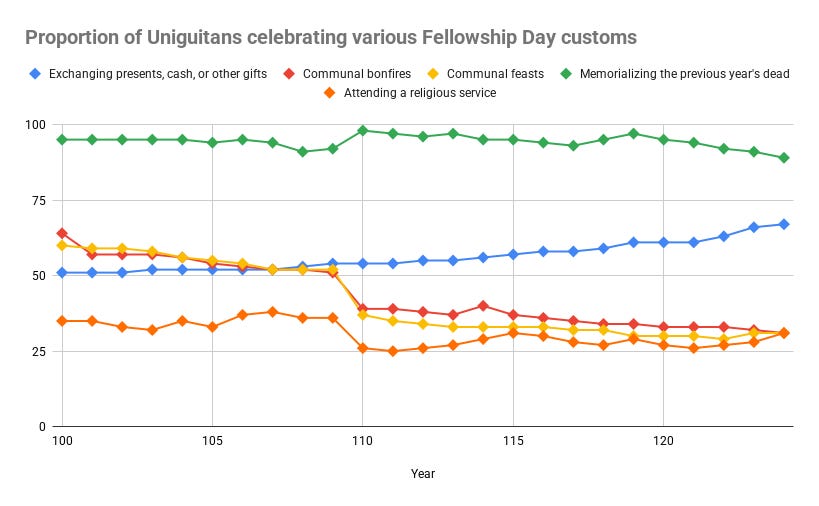
These gloomy statistics seem to be uncorroborated in Puerto Ostra, however.
The percussive boom of a marching band ricochets off the stone facades of the city’s historic downtown, as the Sociedad Honorable de las Cucarachas – “The Honorable Society of the Cockroaches” – practices ahead of tonight’s festivities. Covered in elaborate, papier-mache mockups of the insect, drummers bang their instruments while the brasses and woodwinds bleat out traditional, uptempo arrangements. Vendors in the nearby central plaza hawk holiday wares to parents as their children snack on cockroach and cricket lollipops.
“It’s really fun,” nine-year old Imelda tells me. “The roaches are gross, but the music is really fun.” Her mother, Rosa, says that it gets the kids out of the house during the holiday break. “It’s definitely a lot better than them melting their brains in front of the television,” she says.
“It’s tradition!” her husband Rodolfo chimes in as he unfolds chairs for his family to watch the imminent parade. He shows me an old photo of him as a teenager, decked out head to toe in cockroach regalia. A one-time tenor saxophonist for the Sociedad, Rodolfo bubbles as he describes the old days. “Too many people now just stay locked up inside,” he laments. “They don’t want to do things like this anymore.”
Despite Rodoflo’s complaints, the 125th Cockroach Day Parade appears to be well-attended. Excited families, couples, and inebriated students from the nearby college cheer on the bug-bedecked marchers as they wind their way through town. The rhythm is enchanting, and the dancers impressively complete complex moves under the presumably heavy weight of their costumes.
“La reina!” Imelda shouts, pointing at an approaching float. The Cockroach Queen – clothed in a sort of plastic cockroach chainmail dress, with two antennas shooting from her immaculately styled hair – waves and flashes a grin at the cheering spectators. “We love you, Kiki!” shouts one particularly enthusiastic huddle.
“We’re so proud of Enriqueta,” gushes the queen’s mother, Maria. “She trained all year for the pageant and I think the judges saw that,” she continues. “Though she would have been our Queen regardless.”
While the parade continues, a company of the town’s master chefs prepare a gargantuan feast. Employing likely every cooker and smoker in town, dozens of grillmasters lay down fat, well-marinated slabs of boar chops and venison steaks. The smell alone is intoxicating – one can only imagine the taste.
“My grandad cooked, my dad cooked, and I cook,” says Camelia Ponderosa, 17. She says her father hoped to have a son to carry on the tradition, but that those hopes were dashed by the early death of her mother. “He trained me like I was a boy,” she continues. Standing nearby, her father Nestor beams with pride. “She’s a lot better than I was at her age. Cami’s a star.”
Thousands of celebrants swarm the prepared carnivales, the gigantic, carnival-like tents set up to hold the hungry festival-goers. Thirty volunteers operate the mammoth buffet lines, doling out the traditional game meat, mashed potatoes, and hearty vegetables. Employees from Viñedo de Concordia, a major regional winery, serve up sizable glasses of a fresh red.
The meal is fantastic, complemented by the lively atmosphere. Families and neighbors share laughs, and kids chase each other between the long, wooden tables. After the feast, many of now stuffed and slightly tipsy revelers go outside where a significant bonfire has been set up.
Phillip Parker, a tourist visiting from Nova Espero, say, “Fellowship Day has nothing on this.” He tells me that he attended the City-organized bonfire held downtown last year, but that it doesn’t hold a candle to Puerto Ostra’s celebration. “This is insane. The fire’s huge! And the food’s amazing!” he says through an open smile.
Tomorrow, millions of Uniguitans will awake far too early to their children hammering on their bedroom doors, begging them to wake up so they can open their presents. They’ll receive new mugs, books, and games, or from the uncreative but still generous, envelopes stuffed with cash.
Fewer will go to bonfires, communal feasts, religious ceremonies or the other hallmarks of Fellowship Days past. And while it would be improper to judge anyone for how they celebrate a holiday, I will say that there is something so special about the community events of Fellowship Day. At the communal feasts, you’ll reconnect with people you haven’t seen in years, make new friends, or meet a kind family that just moved to the neighborhood and is desperately looking for playdates for their kids. At the risk of being overly sentimental, the Fellowship Day bonfires will not only heat you up in the very literal sense, but also have the potential to kindle connections with your neighbors.
Fellowship Day once was – and for many still is – a day of camaraderie and warmth amid the depressing, frigid heart of winter. As loneliness increases and civic participation decreases, we would do well to bring back the “fellowship.”