


NOVA ESPERO CITY - QUINTO 30, 126 PM
“Now departing Customs House... please stand clear of the closing doors...”
The Hegeliopolis Metropolitan Railway Project was the product of the regime that built it -- or the one that tried to build it at least. Matching his ambitions for the vast state he controlled, Francisco II so desperately wanted to make Hegeliopolis a true imperial capital of a modern empire. His ambassador to the Ylrikian Empire sent back letters from Irikyo, jealously portraying the “underground railroads” of the rival nation’s metropole. “The stations are frescoed and spectacularly clean,” Oswaldo Perez, Duke of Cabo Grande wrote. “The trains themselves slink below the congested thoroughfares of the City, transporting passengers to and fro at incredible speeds and with unrivaled efficiency.”
Sketched out by the state’s best civil engineers, the first line would connect the Imperial Way -- the wide, manicured axis connecting the Imperial Palace and the Imperial Diet, fronted by the gargantuan mausolea of the Empire’s sprawling bureaucracy -- to a series of tony, soon-to-be-built rail suburbs on the northern shore. On Quinto 29, 1757 O.S. (9 BM)1 the Imperial Works Ministry began to dig in the inner core, and sweep away the rude slums that occupied the future sites of the new towns of Coats and Mist Cove.
But on Deka 28, 1766 O.S., after nine years of work, the project remained unfinished. A few cut and cover rail tunnels had been dug, connecting Palace Station and Coats. But the Empire’s spending on its military, on its weapons technology, and on its ever-growing arsenal of nuclear and thermobaric weaponry, and the resource demands of an expanding war economy meant that no rails were laid, no trains ran, and the “Metro” remained a hole gored deep into the earth and nothing more.
“Now arriving at Old City... doors will open on the right...”
Rebuilding mass transportation infrastructure was not a primary concern of the early inhabitants of Nova Espero. Two years after the Milito, the settlement of 6,000 survivors and citizens comprised the near-totality of the population of old Hegeliopolis, once a city of ten million inhabitants.
Even so, the unfinished system provided an effective means by which scavengers could go out to points beyond the new city’s central core.
“Now arriving at Memorial Circle / Milito Museum... doors will open on the right...”
Time passed. More people flocked to Nova Espero as the Federation leapt its borders outward. Newly incorporated citizens came to serve in the elected Common Council, or to work for the nation’s pre-eminent media outlets that found their headquarters there, or to find other employment in the city’s bountiful offices, factories, printers, bakeries, canneries, and foundries.
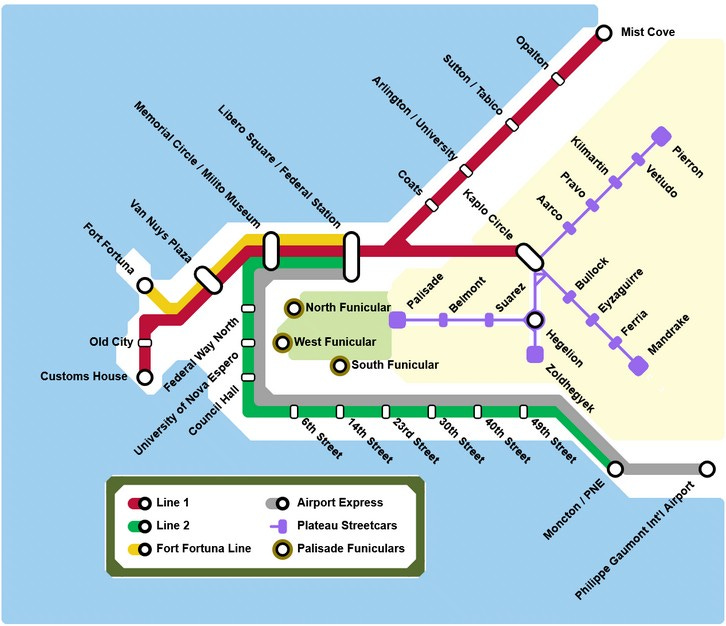
During the 40s, that imperious President Enrico Carmelo revived old Francisco’s vision of a Metro here. He used the old tunnels and his other Great Capital Projects to tell a story -- the line would pass from the Old City, where Nova Espero had been born, and move eastward along the old tunnels to where the city (and the Empire) was headed. Ever the politician, he converted the Palace Station into one connecting passengers to his new Milito Memorial and accompanying museum. Leaving their train, visitors would follow tiled walls with propagandized frescoes depicting stories of woe and despair during the War and subsequent Collapse, depicting the people of Hegeliopolis (and the broader pre-War Empire) as being one burdened by sorrows amid the howling laughter of foreign, Eastern emperors and warlords. They would then pour into the memorial via vomitoria. Massive rows of identical columbaria would hold the ashes of millions of victims of the War in Hegeliopolis, overwhelming visitors with the magnitude of destruction faced by the city’s inhabitants. Little did visitors know that this was all an elaborate framing exercise, one meant to prime the nation’s inhabitants – and the politically important inhabitants of Nova Espero – for war against the Ylrikians.
Though Carmelo avoided the pitfalls of the Old Empire and managed to lay down rails and even open a trunk of Line 1 between the Customs House and Memorial Circle by 43 PM2, he could not resist the temptation of total power. Enrico Carmelo would attempt to seize power in a disastrous failure of a coup attempt in Kvarto 47 PM, just months before a primary jewel in his crown of “Great Capital Projects” would be completed.
“Nun alvenante al Libero Placo / Federacia Stacio… Transiro al: Linio 2, Forta Fortuna Linio… La pordoj malfermiĝos dekstren.”
In the aftermath of Carmelo’s failed coup, the nation was reconstructed and reconfigured in a way not seen since the immediate aftermath of the War. Carmelo and Carmelists were shunned from “good society,” and a new constitution sought to ensure that someone like Carmelo – someone smarter than Carmelo – could not successfully pull off what el jefe had failed to do.
In this period of upheaval and disillusion, President Erika Lankolay sought to restore confidence in government. She tapped Nova Espero Planning Director Frederika Van Nuys – a political agnostic with a million ideas – to dream big and pursue massive changes. A second line would be dug under the Federal Way between the Milito Memorial and a new home for the Common Council, and would bend to connect the working class neighborhoods of the Southern Ward to the employment nodes of the CBD and a to-be-built industrial district that would separate the soot and smog of factories from the homes of their workers.
She would also expand Line 1, fulfilling the dreams of Francisco II in bringing it to Mist Cove, but instead of being the exclusive domain of wealthy well-to-dos, the line would spur the growth of “station cities” to be inhabited by people of all walks of life. On the high, central plateau – long a no-man’s land due to poor transportation connections – vast housing estates and commercial districts would be connected by a series of idyllic median-running trams. And at the tip of that plateau would be Palisades Park, accessible to the laboring classes of the flatlands below by a series of funiculars.
“Now arriving at Mist Cove… Doors will open on the left… This is the end of the trip. Please depart from the train…”
Van Nuys’ ideas were bold, audacious, unimaginably expensive, and triggered a backlash that would stifle such massive projects for generations. More caustic than their costs were the effects they had on surrounding communities. In places like Arlington, Sutton, Tabico, and Opalton, swathes of shanties and more formal urban neighborhoods that had blossomed in the decades following the War were unceremoniously demolished to make way for the Line 1 viaduct’s massive concrete pillars. The residents of these places revolted, throwing bricks at construction workers, filling the gas tanks of construction equipment with sugar, and firebombing site offices.
The people of these communities that had been so maligned by the urban works projects were among the members of the varied coalition that would unceremoniously remove Lankolay’s People’s Party from power in the 60 PM elections. The Conservatives, who had spent thirteen years in the political desert, were back – and there would be no more Frederika Van Nuys. Even so, the land in the affected cities was already cleared – the Line 1 expansion would go forward as planned.
Despite the population of Nova Espero increasing three-fold since the opening of the Line 1 expansion in 63 PM, very little has changed with the Metro. Frequencies have increased, but the only new lines built have been ones connecting Federal Station (and its arriving tourists with suitcases full of cash) with the hotels and casinos of Fort Fortuna, and another connecting the urban core to the recently-finished suburban Philippe Gaumont International Airport.
As a result, the system’s stations and trains are more packed than ever before. Passengers have complained of sardine-like conditions aboard rush hour trains, and the city’s Transportation Department and Police Bureau have warned of “crowd crunch” conditions at certain stations. And as the Plateau neighborhoods continue to develop and densify, analysts say that, despite their quaintness and the fondness local residents have for them, the Plateau trolleys are well past their useful life in terms of capacity.
“Now arriving at Moncton… Doors will open on the left… This is the end of the trip... Please depart from the train…”
Compared to the trains, parks, and the massive housing towers of Van Nuys Plaza, Frederika Van Nuys’ project at Moncton is often overlooked. Prior to its construction, dockyards and factories clung to the southern shores of the city, clotting the air of the poorer Southern Ward with a thick, brown-black haze of particulate matter. Van Nuys sought to ameliorate the issue by shifting these industrial uses to Moncton, then on the outer fringes of the city. The plan worked – but with the advent of nuclear energy and the proliferation of massive renewable energy projects, the coal-burning stacks that choked the lungs and throats of Southern Ward residents are now long gone. Though the industrial uses are unseemly, technology has largely solved the problem of pollution – were the idea to be proposed today, Moncton Industrial Area might not exist.
Some will point to the auto and claim that to build new trains is to engage in outmoded transportation strategies. When Van Nuys ballooned the Metro, less than 10% of Uniguitan households had access to an automobile – today, nearly 50% do. What cities need now are highways and boulevards, not trains, according to many in the urban planning community. The recently proposed Federal Budget would allocate millions more notes to roadways than in previous years, and the amount of funding for mass transit projects has dipped in recent years despite increasing costs and growing maintenance backlogs.
When zoning for industrial uses was explored for the Southern Ward recently, the community still stood in stiff opposition. Despite changes in technology that have made factories less pollution-intensive, the residents were still vehemently opposed to industrial uses being in their neighborhood. Outside of the Southern Ward, this was seen as irrational – but to local residents, many of whom worked in Moncton, they knew that the smoke and the soot weren’t the only problems, but also truck traffic and ceaseless noise of industry. Despite the heckles of well-to-do people outside the district, the residents knew the realities on the ground. Where you stand often depends on where you sit.
Of the 50% of households in Uniguita – and 20% in Nova Espero more specifically – that have access to a car, they are on average wealthier than households that do not have access to a car. Residents who rely on transit are, on average, poorer. To build out highways at the expense of transit would be akin to Francisco II’s old vision to build the Metro to serve only the toniest of wards in his new Imperial Capital.
O.S. stands for “Old Style.” These years are written using the pre-War calendar. “9 BM” stands for “11 [years before the Milito].” The Milito was the catastrophic nuclear/conventional war that largely destroyed developed civilization on the continent some 126 years ago.
PM stands for “Post Milito” or “after the War.”