



PIERRON, P.N. – DUO 24, 126 PM
“Tabernac!” fisherman Jean-Pierre Fournier exclaims as he frantically yanks on his fishing pole. Tugging and reeling, the seasoned angler grits his teeth as the massive walleye erupts from the hole carved into the ice below. Five-year-old Philippe Fournier, buried under layers of winter weather gear, claps his gloved hands together excitedly. “C’est énorme, papa!” he shouts.
On the frigid ice of Ultime Cove under the watchful eye of Old Pierron’s medieval parapets, father and son Fournier embrace. The Fourniers are just two in the long line of ice fishers that have long plied these icy waters adjacent to one of the nation’s largest cities. Rising temperatures, however, could see this long-standing tradition soon thaw out of existence.
Fishing to shipping to fishing again
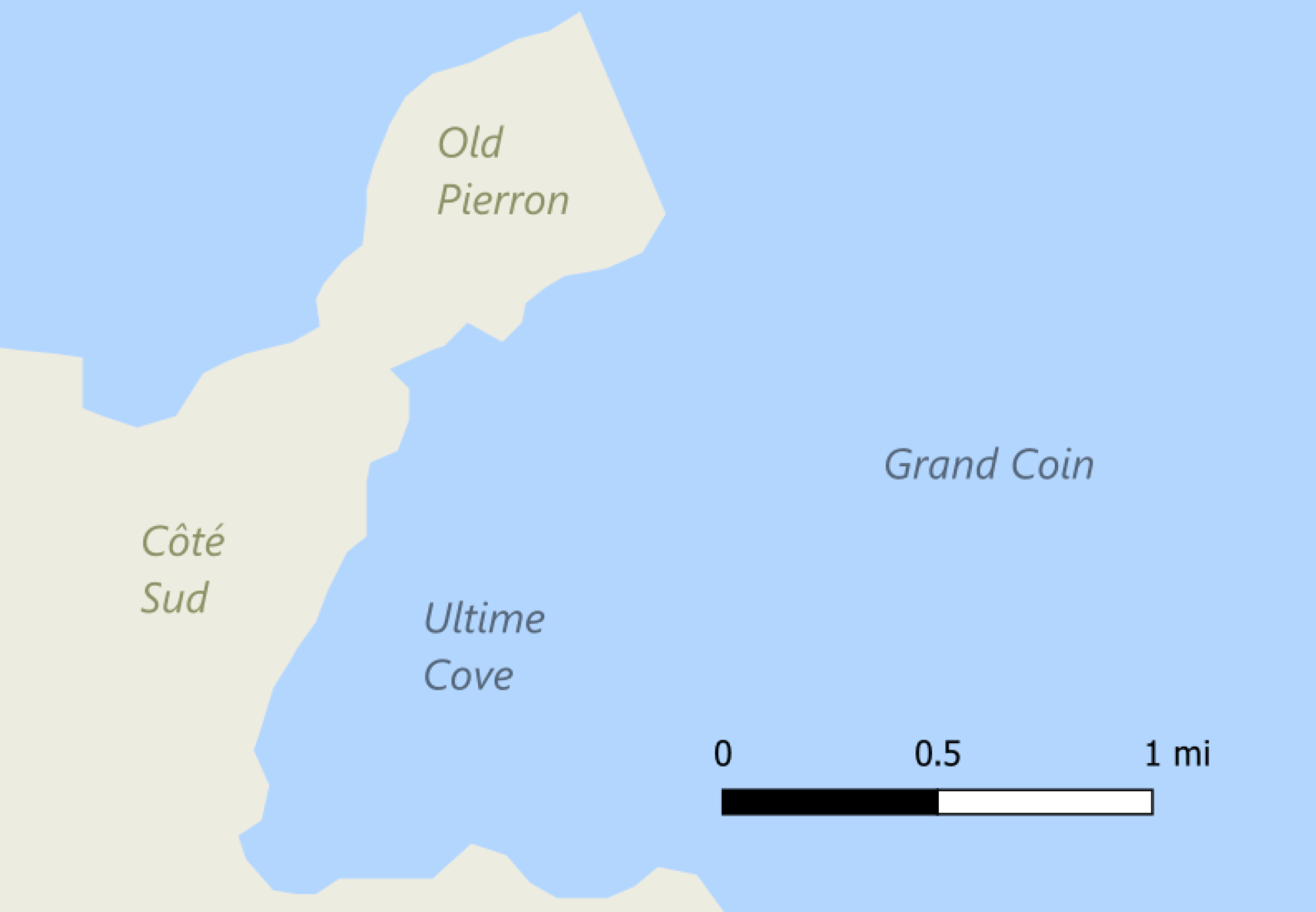
Pierron was initially founded on the heights overlooking the Grand Coin, the massive estuary where the Pierron River meets the Great Inland Sea. The Grand Coin was replete with fish, and walleye and pike became mainstays of the area’s diet. Just south of the settlement’s center sits Ultime Cove, a large, relatively shallow pool that served as a common fishing spot in early Pierron.
“During winter, the conditions on the sea and the Grand Coin are absolutely horrid,” says Sophie Denaurd, an associate historian at the Pierron Maritime Museum. She shows me the bell of the Fontenot, a fishing vessel that succumbed to the sea’s turbulent waters a few years before the Milito, taking fifty-three sailors with it. She points to a dark red mark on the adjacent wall thirty feet up, the estimated height of the waves that sent the Fontenot to the seafloor.
Denaurd explains that if a great, steel fishing vessel like the Fontenot faced grave danger in the wintertime seas, the small wooden dinghies of the medieval times were in even greater danger.
Ultime Cove, shielded from the ferocious winds and waves of the Great Inland Sea and the broader Grand Coin made for a well-protected fishing spot. When the Cove froze over, Pieronnaise fishers bored holes into the ice and got to work. The yearly hauls would supplement grain sent aboard river barges from further inland, ensuring that Pierron didn’t starve during the region’s long and brutal winters. Even on summer days, the cove was regularly filled with small fishing boats.
As transportation modernized, industrialists and food shippers found the Cove to be a valuable location to take in freighters and barges to transfer goods to newly built rail lines for transport to Terre de Lac’s non-riverine and non-coastal cities. Additionally, the city’s rapid industrialization and expansion in the decades leading up to the Milito led to something called the “urban heat island effect.”
“All of those new dark surfaces – think apartment blocks, roads, factories, railyards, and even sidewalks – suck up a lot more heat than, say, the native forest that existed before,” says Étiennette Desvaliers, an employee of the city’s park system which oversees ice fishing at Ultime Cove. This additional heat caused the ice of the Cove to recede, leaving less space and time for the once common fishermen during the winter months.
Being a major port city, Pierron faced heavy bombardment during the Milito. Like Nova Espero, much of its older core was spared the worst of the damage, and the city’s survivors found security behind its ancient walls. But with the War came a critical food shortage.
“They didn’t have access to those giant fishing boats anymore, and even if they did, the seas were absolutely lethal in those first few years,” Sophie Denaurd tells me. The climatic effects of the Milito were catastrophic in Terre de Lac, creating massive storm surges that pummeled the already severely damaged city’s northern shore and swept a number of fledgling coastal fishing villages out to sea. Not to mention the frequent subzero conditions and blizzards that would dump upwards of two feet of snow on the area, boxing in the local inhabitants.
Ultime Cove, now refreezing, provided an opportunity.
After the father-son fishing trip, Jean-Pierre takes me to his family’s (thankfully, very warm) home in Pierron’s rapidly growing Côté Sud neighborhood just a few blocks away. As teenage Claire shows Philippe how to cut and clean the walleye, Jean-Pierre shows me a well-worn photo album. He points to a photo of a couple taken just a few short years before the War.
“When they were running off to a shelter, my great-great grandmother, Marie, put a photo album and her old camera in her bag. Her husband, Jean-Luc, said, ‘Marie, what the hell are you doing! What use is that junk’”, he recalls with a chuckle. “I’m glad she didn’t listen!”
After showing me some more photos of the Fournier ancestors, he moves on to the album’s post-War section. It documents Pierron’s damaged buildings, burnt-out vehicles, and ad hoc shantytowns, but also the community’s resilience in the face of adversity. One photo, marked “Le Grand Butin” – “the great bounty” – shows a grinning Jean-Luc and his fellow survivors on Ultime Cove, standing arm in arm behind a massive pile of fish. Another shows them cooking the “bounty” over wire baskets and other impromptu grills.
“Things were hard back then,” Jean-Pierre tells me. “But the people here are tough – ‘en marche!” he says, quoting the city’s slogan which translates to “onward!”
Thinning ice
As Pierron and the other Lacaise commonwealths joined Uniguita and the trade economy came back, so too did the Ultime dockyards. Freight traffic crowded out the Cove to warm-weather fishers by the early 30s PM, but once again, as soon as the ice returned around Dekaduo each year, ramshackle ice-shanties appeared atop the ice.
At the Ultime Public Market just two blocks from the waterfront, Jean-Pierre’s great-grandfather, then grandfather, and then father, had a small stall where they would sell their catches. Walleye were the hottest commodity, as were the mussels that scummed the covebed. The poissonnerie served customers from 33 PM to 117 PM, transcending three generations of the Fournier family. Rising costs, diminishing fish populations, and changing appetites among marketgoers – the Fourniers’ old stall is now occupied by a Bawguk gimbap stand – ultimately led to the stall’s closure under Jean-Pierre’s father.
“He was sad to see it go,” he says at first with a wistful look in his eyes. His expression soon changes to a smirk. “But he seems plenty happy with mom down in the sun of the Gold Coast.”
Jean-Pierre carries on the family tradition with his children and their ice-fishing adventures on the Cove. But a changing microclimate may be putting that under threat. As a result of Pierron’s rapid expansion over the past several years, the city’s “urban heat island” is returning and growing in temperature.
“Because Côté Sud right next to the water is developing so quickly, and because we’ve finally ended the decades-long recovery from the post-War ‘little ice age’ the ice is thickening less quickly and receding more quickly than we’d like,” Étiennette Desvaliers explains.
Though Desvaliers says that the ice is still safely thick to support human beings and even lightweight shanties in the dead of winter, things are getting more hazardous in the late-fall and early-spring. Tragedy struck on Dekaduo 19, 123 PM when a father was severely injured and his two daughters drowned after their fishing shanty broke through the ice. On Trio 3, 125 PM, two teenagers suffered life-threatening frostbite and hypothermia when the ice beneath them gave way.
In response, officials have closed Ultime Cove to ice fishing prior to Fellowship Day (Dekaduo 22) and after Trio 1. And Parcs Pierron now hires two seasonal “ice inspectors” to check the ice’s thickness on a weekly basis, setting down barriers to prevent visitors from stepping out onto potentially-hazardous sections.
Jean-Pierre points out the neon-orange, plastic construction fences as we near the waterfront. He translates a bright white warning sign bearing the haunting silhouette of someone drowning amid chunks of floating ice.
“‘Warning – The ice ahead is perilous. People have died here. Please stay out.’” he reads.
Well away from the ominous alert, I join Jean-Pierre and Philippe as they prepare for another day of fishing. “The ice is good, we’re good,” the younger Fournier says.
They cross their fingers for more walleyes.