


PUERTO BLANCO, F.A. - UNUO 29, 126 PM
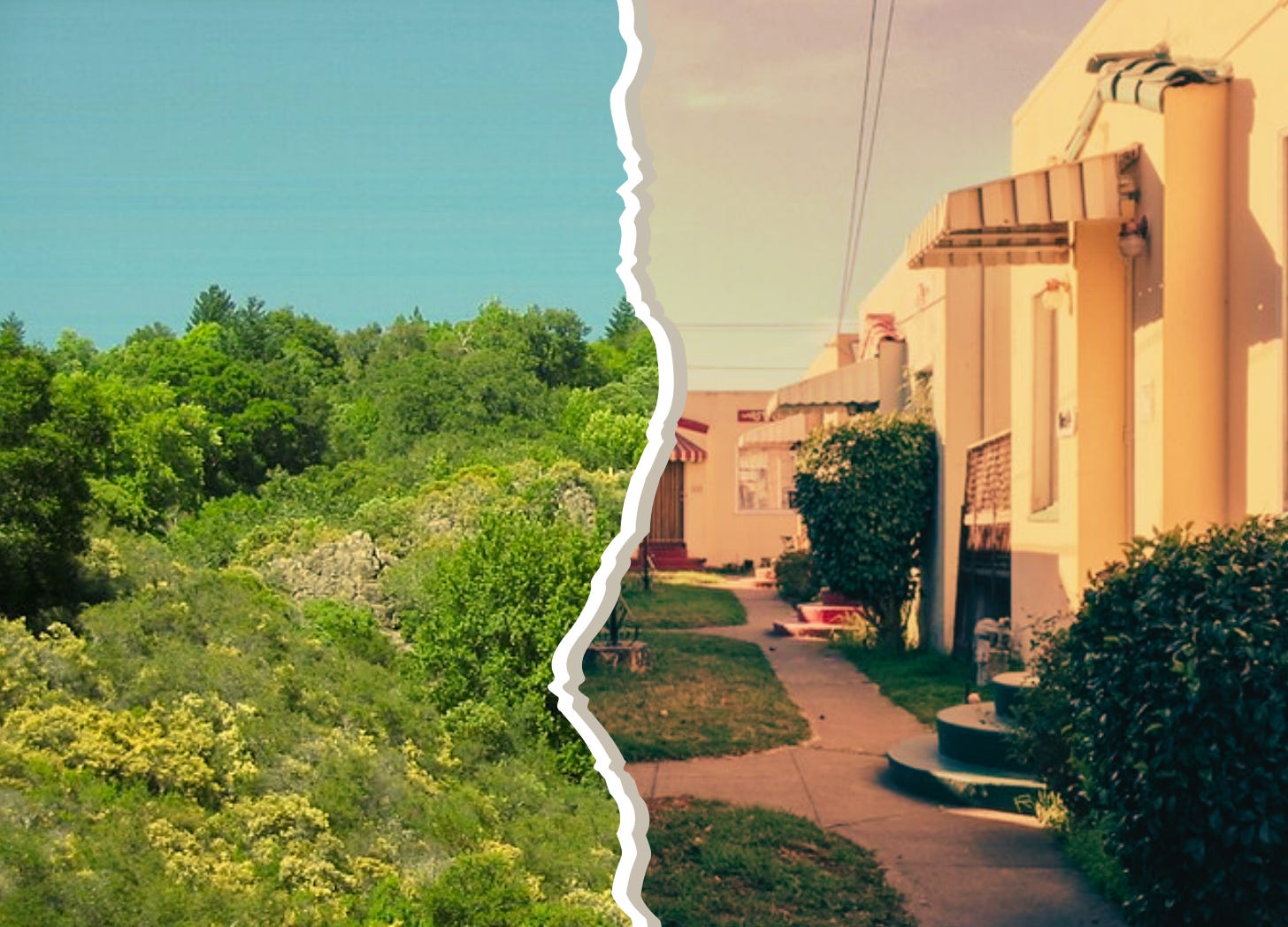
On the hills overlooking Puerto Blanco lie the city’s historic badlands. Though some blocks are overgrown with the scrub grasses and wildflowers that once dominated the landscape, others are now occupied by dense clusters of small cottages. The homes themselves cling close to the street, with long, fenced-in yards in the back, taking the familiar form of the countless “summer villages” that have popped up on the outskirts of cities from Nova Espero to Sherbrooke.
With Ferria recently relaxing restrictions on badlands construction, such developments are springing up in the long-abandoned outer reaches of one of the nation’s largest metro areas. Realtor Eduardo Ramos sees a major opportunity in the new communities. “Before, people had to go all the way up into the mountains or across the straits to Isla Larga to get away from the city,” he tells me in the quaint but well-appointed living room of one of the new constructions. “Now, they can just go up into the hills.”
Others, like Isabela Viñas of the Ferrian Conservation Association say that the badlands provide a vital “middle” habitat for wildlife and a recreational outlet for urbanite blanqueros. “These are areas with naturally occurring tall grasses and young oak trees right near a major city,” she says at the edge of a surprisingly lush block around three miles outside the city center. “There are so many animals that have been gone for centuries that have now returned because we’ve cleared these spaces and finally left them alone. Why should we spoil this?”
In central Puerto Blanco, meanwhile, the Watson family excitedly reviews mortgage paperwork for a nascent suburban development that has bountiful parkland, new schools, and lower housing costs than in the crowded city center. “It’s an opportunity for us – we’ve never been able to own a home and now we finally might be able to,” baker and household matriarch Frederica Watson tells me.
For the past half of a century, Puerto Blanco and Ferria have struggled to figure out what to do with the thousands of acres of once-urban land surrounding Uniguita’s second-largest city. Though new policy means that more of the land can be developed than before, what should happen to the rest? Should it be urbanized, suburbanized, or left to the whims of an encroaching natural world?
The birth of the badlands
The bombings and subsequent firestorms of the Milito destroyed tens of thousands of square miles of neighborhoods, industrial districts, and commercial districts in what is now Uniguita. Nearly every major city on the continent suffered cataclysmic damage, and small, disparate settlements began springing up out of the ashes of collapsed metropolises. During the Collapse era immediately following the War, however, there was a pressure to consolidate surviving populations.
“This was a time where there were still marauding raiders in the backcountry, and warlords roaming through the plains,” says Lector Nestor Raigosa, a historian at the Puerto Blanco House of Wisdom. “Having a constellation of tiny settlements made survivors vulnerable to attack and made resource distribution more difficult.”
With improved energy infrastructure and intact construction equipment at their disposal, the Uniguitan government crafted a plan. Populations would be resettled in concentrated urban centers, and the ruined once-urban periphery of the settled areas would be cleared for agricultural use and the debris sorted and salvaged for rebuilding the cities. These depopulated and deconstructed areas would be referred to as “badlands.”
“This was meant to be a temporary measure,” Lr. Raigosa continues. “Badlands are what you would call ‘marginal’ for agricultural use. They were filled with concrete foundations, buried fuel tanks, and industrial waste runoff. It’s not very good land. But it was available, and it was defensible. That’s what mattered.”
The federal government oversaw the administration and delineation of the badlands. Thousands were put to work clearing blocks of land, sorting through rubble for usable scraps. As a result, for decades most cities contained massive yards filled with millions of bricks, pipes, chewed up concrete, and other materials that made reconstruction in the settled areas cheaper and easier. The policy also opened up land for growing potatoes, beets, and other hardy vegetables capable of withstanding the difficult soils of urban Uniguita.
As security within the Federation improved and the country incorporated the Fertile Center as an agricultural engine, the need for growing food on this “marginal” land near cities declined. With government efficiency requirements coming into vogue during the Liberal administration of President Karlo Plagad (29 PM - 40 PM), the badlands became useful as municipal service boundaries. With the Urban Service Distribution Act of 31 PM, cities were barred from distributing services out to areas within the badlands. The goal was to cut costs in sending water, power, and law enforcement out to the disconnected outskirts.
But natural population growth meant that settlement jumped these artificial urban boundaries. In places like Nova Espero and Puerto Blanco, where the understaffed national bureaucracy of the Office of Badlands Management (OBM) took years to respond to boundary expansion requests, informal settlements popped up in the outskirts. Poor and working class residents of these cities found shelter in handmade shanties and in abandoned structures that were deemed “too historically significant” to bulldoze outright during the clearing process.
One such building was the Brenntag in Nova Espero’s impoverished Southern Ward. Once an upper-class apartment house for Hegeliopolis’ wealthy elites, the building had become an overcrowded and underserviced tenement by the 40s.
“Because there were no active water lines, residents had to go down ten blocks to a municipal spigot to get their water every day,” says Marcia Polk, a docent at the Brenntag Tenement Museum in Nova Espero. “And no services – sewage, emergency services, building inspections – made them vulnerable to crime, disease, and fire.”
On the sweltering night of Septo 17, 46 PM, amid a crime crackdown under the increasingly authoritarian administration of President Enrico Carmelo, undertrained military units attempted a raid against drug traffickers believed to be occupying several apartments within the building. At the onset of the operation, a soldier launched a smoke canister into a window which ignited a fire that would consume the entire building. With no running water in the area, it took hours of firefighters scrambling to and from the nearest water source nearly a mile away to put the blaze out. As a result, over a hundred of the building’s impoverished residents perished.
“It was a catastrophic disaster,” says Polk, showing me a charred children’s book found in the aftermath.
In the years following the inferno, there grew a nationwide pressure campaign to reform the badlands system. That reform would come under President Lankolay.
A new era
Though badlands management reform was far from the top of President Erika Lankolay’s list of priorities when she took office amid a political and economic crisis in 48 PM, the issue was addressed. Just a few days after taking office, she appointed Taylor Cosgrove the administrator of OBM, who went about making radical changes to the badlands bureaucracy. With help from the Common Council, Cosgrove eliminated the federal bureaucracy entirely and created regional badlands administrations informed by federal policy “guidelines.” This regionalization expedited the urban expansion permitting process, meaning that cities would not have to wait up to five years for their applications to go through. A development boom ensued, with more formal housing, industrial, and commercial districts being built wholecloth in the close-in areas previously off-limits to legal construction.
During the Conservative administration of President Fernando Pelar in the 60s, Council further decentralized badlands management, by turning over administration to the commonwealths. Some, particularly those in the Fertile Center and the West Coast permitted wholesale redevelopment, with stations being constructed along the newly rebuilt Federal Rail lines to create commuter suburbs and “summer villages.” These hamlets became ubiquitous in the urban periphery as middle- and upper-class residents of the nation’s cities sought nearby refuge in the comparatively quiet hinterlands.
In some cities, industrial plants were exiled to the far-flung reaches of the badlands to separate polluters from the city center, with interurban lines being built to connect urban workers with their remote workplaces. Other undesirable uses were located in badlands areas, such as landfills, water treatment plants, and even prisons. In a bid to earn some extra cash, Swalabash City even sold some of its badlands back to the federal government to use as a bombing range.
Others took a different path. In the capital of the wealthy commonwealth of West Ferria, Puerto Ostra’s badlands were divided between urban development and a massive public park. The park – replete with football pitches, forested glens, artificial lakes, a renowned natural history museum, and stadiums from when the city hosted the Continental Games in 112 PM – has become a treasured part of the city’s urban fabric. In Pierron, much of their vast badlands were set aside for “re-wilding” and parkland, as was the case in other northern urban areas like Calumet and Vetludo. Some dedicated portions of their badlands to the construction of universities, including Nova Espero which has set aside several hundred acres to a new, sprawling campus for the city’s flagship higher educational institution.
The pressures between conservation and development became a common theme throughout Uniguita. Commonwealths, cities, and local interest groups waged war over whether or not to build housing, industrial parks, recreational facilities, or just give the land back to the heavily damaged natural world. Development pressures have won out in most places, but in others where conclusive decisions have yet to be made, those battles are ongoing.
The battle over Puerto Blanco’s badlands
“So this is the imperial-era post office, dating back to a century before the War,” says Ramos as he shows me a renovated, two story structure with a white stucco facade. “Obviously the wood beams got burned up, but I’m glad they didn’t bulldoze the shell. People love these old buildings.” Ramos radiates excitement as he points out a shockingly well-preserved fresco depicting a postman on horseback. He explains that the old post office will be a centerpiece of the still-under construction Pueblo Alto development, with realty offices on the second floor and a community hall on the first. Nearby, workers busy themselves with the finishing touches on a modular train station, meant to welcome the vacationing passengers from the bustling urban center just a few miles away.
For more than half a century, Puerto Blanco and the Ferrian commonwealth government were deadlocked over what to do with the city’s badlands. Most of those living in the commonwealth wanted to turn it into a park, while representatives from the city wanted it to open for development. With neither wrangling the necessary support for their plan, the area continued to be consumed by weeds, grasses, and trees of increasing heights. Wildlife returned to the shadows of this glittering urban agglomeration for the first time in over a century.
The constrained size of developable land gives Puerto Blanco its characteristic hyperdensity, as well as its housing affordability crisis. According to the 121 PM Uniguitan Census, more than half the city’s residents spent upwards of 30% of their monthly incomes on housing expenses. For comparison’s sake, the census also found that just a tenth of Uniguitans overall are similarly cost-burdened, as well as just a quarter of Nova Espero’s residents.
After decades of gridlock – and increasing fears from rural Ferrians of blanquero housing refugees crowding out their small hamlets – a deal was reached last year. The urban core of Puerto Blanco would be expanded, and further development would be allowed along major highways and rail lines. Though most of the badlands would still be blocked from development, this would more than double the developable footprint of the city.
Ramos confirms that the pent-up demand has been released on an unimaginable scale. “Our lots went on the market about two weeks ago… there were around 650 of them,” he says. “Of those 650, all but ten have been sold. People want to get out of the city, at least on the weekends.”
Around two miles away, Isabela Viñas takes me to a yet-undeveloped area of the badlands. She shows me a family of tortoises sunning themselves near a babbling creek. This area was a park prior to the War, and has become a borderline wilderness in the century and a quarter since. We also see deer, antelope, and even a brown bear cub.
“Oh shit,” she says, laughing nervously under her breath. “We should probably get out of here. We don’t want to be around if mama comes back.”
This patch of land sits around a half mile from the nearest rail line, putting it well within the developable zone if a developer chooses to build a station nearby. According to Viñas, the company Ramos works for is planning to do just that.
“It’s beautiful, it’s really beautiful. And that’s just it. The best way to keep it that way is to leave it alone,” she tells me. She doesn’t mind the hikers or mountain bikers – we see a few and wave as we navigate the “wilds” – but she explains that intense development would ruin the area.
“All of the trash, all of the pipes, all of the clearing, all of the construction – it would do a great deal of damage to the animals and the ecology,” she says. “And for what? Summer cottages and suburbs?”
Meanwhile in Puerto Blanco’s east side, Frederica Watson meets me outside of her apartment building. She leads me through the confined but tastefully decorated lobby, and over to the elevator. Built in the 70s, one must open the elevator gate oneself to enter and depart. We slowly climb to the sixteenth floor, entering her tightly-packed apartment which contains three, efficiently appropriated bedrooms.
“When this place came up and we were able to put a deposit down, we almost cried.” She explains that before this, she, her husband, and her two sons lived in an even smaller two-bedroom on the other side of the city. “It was okay when they were little kids, they were becoming teenagers, you know? If you try to cram two teenage boys in the same bedroom, they’ll kill each other.”
Even with the additional bedroom, the Watsons find the conditions cramped, not to mention expensive. Frederica tells me the monthly rent here is N4001 – more than half of her and her husband Thomas’ combined monthly income from the small bakery they run a few blocks away.
A few days before our conversation, the Watsons visited an under-construction development near Ramos’ Pueblo Alto. She shows me the brochure for the community, where a three-bedroom rowhouse can be had at a mortgage costing just N3502 per month.
“The houses all had backyards, and they’re building all sorts of new schools, shops, and rec centers out there,” she says giddily. Though N75,0003 would be a high price to pay for a home in much of the rest of the country, it’s an improvement over the N90,000 to N100,0004 price tags on three-bedroom apartments in the city.
“It’s all very exciting,” she says. Watson loves Puerto Blanco, and she and Thomas want their children to live their lives here. To them, the new developments on the outskirts make that more of a possibility.
In the historic Republic Hall in central Puerto Blanco, debates continue to rage over the city’s badlands. Commonwealth legislators disagree over what to do with the remainder of the territory, and others still want to halt ongoing development. The new legislation passed last year will likely hold – but for the thousands of acres that remain untouchable for now at least, the future is uncertain.
“We have all of this land that has mostly been graded, that has been settled in the past, and is ripe for development, and at the same time, a real estate crisis” says Liberal Member of Assembly Rodrigo Patton. “I don’t understand why this isn’t a no-brainer.”
On the other side of the aisle, rural assemblyman and member of the Alliance for Nature party Leonel Beeckman says that the land should be re-wilded, as in Pierron. “We’ve carved so many unhealable scars into nature, both before the Milito and after. It’s time we correct our mistakes.”
As these debates persist, bulldozers, construction workers, and armies of prospective homebuyers venture into what were once the city’s desolate badlands. For now, it looks like the development will be contained along the transportation arteries – but for how long, depends on the direction of the political winds in Republic Hall.
Editor’s note: A previous version of this article stated that President Fernando Pelar was a member of the Liberal party. This is incorrect — he was a member of the Conservative party.
[OOC: About $3,340 in 2026 US dollars]
[OOC: About $2,920 in 2026 US dollars]
[OOC: About $630,000 in 2026 US dollars]
[OOC: About $750K - $835K in 2026 US dollars]