


KETFOLYO and FEKETEFOLD, Z.H. – UNUO 13, 126 PM
Hundreds of legislators and onlookers pack the gilded chambers of Parliament Hall in the Zoldish capital of Ketfolyo. Members of the Conservative Party, recently elected the majority, applaud as their leader Laszlo Barcza takes to the podium. Just a few moments ago, Barcza was voted in as the commonwealth’s first right-wing premier since the end of the civil war more than thirty years ago.
The dentist turned politician greets the chamber with a characteristically wide smile, saying quiet thank yous into the microphone and saluting his allies with enthusiastic waves.
He begins in a manner characteristic of a typical, largely formulaic regional inaugural address. “Thank you, to my fellow Zolds,” he starts, “for putting your faith in myself and this Government to carry out the duties ascribed to us in our great commonwealth’s constitution.” Barcza congratulates the class of newly sworn-in freshmen members of parliament, applauding their “zeal and determination for participating in the public square and in public service.”
As the speech continues, however, it takes a harsher tone. “For a generation, our people have been taught to be ashamed of our Zoldishness,” he says. “To be ashamed of our faith. To be ashamed of our heritage and our history. Well today, that generation of humiliation comes to an end, and Zoldhegyek shall raise its head to a restored dignity.” This line earns enthusiastic applause from his fellow Conservatives, and looks of nauseated contempt from the Liberals, Populists, and other members of the Zoldish opposition.
Barcza chides the media and Nova Espero for their ridicule of the mountainous, highly religious commonwealth. He derides the former People’s Party-led government for making Zoldhegyek a “laughing stock” and for being the, “most brazenly corrupt administration the Zoldish people had ever seen.” The premier promises an end to the “radicalization and shaming” of Zoldish youth in the commonwealth’s public schools, and a renewed state support for religious schools.
The Uniguitan left has long prided itself on its “cleaning” of the once-archconservative region, setting up a liberal government in the aftermath of the civil war. Thirty-one years after peace was established, however, the right has come back with a vengeance. In last year’s general election, the local chapter of the Conservative Party won an outright majority in the chamber for the first time.
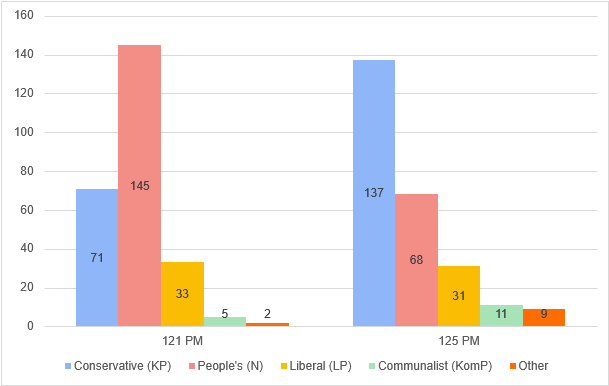
The ruling party losing ground when a member of their party is in power in Nova Espero is not uncommon. Given Populist President Adamo Lojaleco’s sagging popularity, the Poppies expected a bruising cycle. When Election Day came, however, the results were catastrophic, with the party losing 77 of their 145 seats. “We thought we’d lose the icing,” one Populist legislator told me. “Instead we lost the whole cake.”
The whole cake | Change in the composition of Zoldish Parliament from 121 PM to 125 PM
Barcza’s ascent inspires shock, anger, and fear among the Zoldish left, ethnic minorities
In the highly-educated, white collar Kanyar neighborhood around a half-mile down the Fekete River from Parliamentary Hall, the results of last Dekaunuo’s election were a shock. “Barcza is a lunatic,” Anisa, 31, tells me. An employee of a local homeless shelter and lifelong supporter of the Liberal Party, Anisa says that she doesn’t know a single Conservative voter. “Maybe I’m in a bubble, but there’s no way it’s that lopsided, right? So many people live here, and no one I know voted for them. Do they all live out in the hollows?”
In this tony ward, its streets lined with upscale coffeeshops, new apartments, and fashionable barbers, the windows display signs in support of Zoldhegyek’s ethnic, religious, linguistic minorities, who face continuous attacks from the right. During last year’s campaign, Premier Barcza faced criticism when he said that Pravish speakers needed to “get literate,” and that followers of the Mohengduist faith were, “impotents busying themselves with feminizing society.”
“He and the rest of the Conservatives are hateful bigots,” says Pawel, an ethnic Prav and Communalist voter. “Barcza learned how to dress things up in a friendly way, but we know who he really is.”
He points out another sign in a nearby window. It reads “Barcza bűnös!” – “Barcza is guilty.” It refers to allegations Barcza faced during the election related to his past involvement with the far-right extremist group, the Zoldish National Army (ZNH). Some charged that he participated in the group when it engaged in an attempted ethnic cleansing of Pravish people from Zoldhegyek during the Bloody Week of 91 PM. In 123 PM, Barcza was acquitted of federal charges related to his ZNH membership. As the case was dismissed primarily on procedural grounds – the defense discovered crucial evidence had been harvested during a warrantless search – many on the left continue to believe the allegations against the new premier.
“He’s a murderer and a thug. I’ll never forgive the People’s Party for botching that investigation,” says Pawel, whose uncle was killed by ZNH forces during the Bloody Week.
Contributing to fears among the left and Pravs in particular is the increase in far-right extremist activity in Ketfolyo. On the eve of Barcza’s inauguration, hundreds of members of the group “Brothers of Zoldhegyek” marched through the Pravish neighborhood of Alsodal. In Kanyar, posters calling for the “death of leftist scum” were plastered on lightpoles in the days leading up to the election.
“I hope things stay peaceful,” Pawel tells me with some anxiety in his voice. “Knowing the nationalists though, I doubt they will.”
The Zoldish hinterlands celebrate the Conservatives’ rise
Sitting on the front porch of a service station in Feketefold, a rural hamlet fifty miles from the Zoldish capital, Magdalena, 73, provides a much sunnier assessment of the new government. “They’re going to take our nation back. They’re going to sweep out the house, and take our nation back.”
“Sweep out the house!” – “Seperjük ki!” in Zoldish – is a common expression on yard signs, flags, and bumper stickers out here. Starting out as a Conservative promise to root out corruption and “career politicians” in Ketfolyo, the phrase became wider in scope as the campaign increased in temperature. Wielding a broom at a rally on Deka 19, the Conservative candidate for Feketefold’s seat told a crowd that it was time to “sweep out the human trash that pollutes our streets!” Even after harsh rebukes from the media and her opponents, the candidate refused to recant the remarks.
“Why should I apologize? I was telling the truth.” MP Timia Kalyos tells me at her constituency office. “The people clearly agree. Why should I disagree with the people?”
Feketefold is a typical representative of Zoldhegyek’s shift rightward over the past several years. Prior to the civil war, the area consistently voted for members of the right-wing Security and Justice Party. When the party became entangled with the northern secessionist movement and was banned in 92 PM, the area shifted its support towards the People’s Party. The longtime Populist MP for the area, Matias Zsigo, trended on the conservative side of the party and placated his constituents with large public works projects and well-placed nods to the region’s religious traditionalism. In 107 PM, for example, Zsigo was instrumental in passing a mandate for schoolchildren to learn about Zoldish saints in secular schools.
Things have changed over the past few years, however. The Conservative Party, which gradually gained ground among the commonwealth’s right-wing throughout the 100s and 110s, capitalized on the local unpopularity of the progressive Populist government of President Adamo Lojaleco. They agitated on concerns over Zoldish language education in Zoldhegyek’s schools, pillorying Zsigo for voting in favor of a bill that would allow for limited Pravish instruction in select regions of the commonwealth. Kalyos called him a “fake conservative,” who failed to truly understand the needs and wants of the area’s residents. Wealthy conservatives from Hegelion and Ferria dumped tens of thousands of notes into the region’s campaigns, plastering Kalyos’ face and voice on the airwaves, at bus stops, and in newspapers.
The Conservatives’ campaign worked. Despite regularly winning elections by upwards of 30 or 40% in prior years, Zsigo was ousted by the Conservative Kalyos by nearly ten points in the Dekaunuo election. His story wasn’t unique, either. Dozens of Poppies lost seats just like Feketefold to culture warrior Conservatives across the commonwealth.
Ricardo Zaszik, a local carpenter and longtime People’s Party voter, tells me why he voted for Kalyos. “The Poppies didn’t listen to us anymore,” he says. “We didn’t want a new school, or new roads, or a new bus route. We were fine with things here the way they were. What we really wanted was our Zoldhegyek back: with a Zoldish language, Zoldish culture, and a Zoldish God.”
Looking forward, to this year’s elections and beyond
According to the latest Universalo poll, President Lojaleco has an approval rating of just 43%, and political analysts expect his People’s Party to lose ground in the Common Council in this year’s midterm elections. Though a blowout like that in Zoldhegyek is far from likely to occur, the Conservatives have been picking up ground outside their traditional heartland in rural Hegelion and Ferria, the Central Plains, and the well-heeled suburbs of coastal cities. Conservatives have noticed increased membership from working class wards of major cities, and traditional industrial Poppie strongholds like Terre des Lacs and Sherbrooke.
Though the national Conservative Party is much more moderate than that in Zoldhegyek, the far-right is increasing in strength. Roughly one in four Conservatives polled told the Universalo that they would vote for Barcza or far-right Common Councilor William Updyke in their party’s presidential primary in 128 PM. Even so, the moderate Conservative premier of North Hegelion Howard Cate says that people like Barcza, “are a hazard to the party.”
“When people like him come in and hurl slurs and invectives, they make us look like cretins,” says Cate, another potential contender for the Conservative nomination. “They’re too extreme, they’re too radical, and they’d never win on the national level.”
Though Cate’s words seem to ring true in the polling data, it remains to be seen what potential strength the ascendant far-right could wield even as a minority faction. How beholden would a Conservative majority in the Common Council be to figures like Barcza and Updyke? To what demands would moderates like Cate need to concede?
We should watch Zoldhegyek very closely – it could portend for things to come.