


Unlike most articles, this is not a “dispatch” – instead, Mikaelo wanted to take this space to briefly explain the upcoming midterm elections in Uniguita. Despite the best efforts of Uniguita’s fabulous civics teachers and the national media, the process can still feel opaque and complicated to voters and non-voting observers alike.
On Septago, Dekaunuo 1, millions of Uniguitans will go to the polls to cast their vote in thousands of federal, commonwealth, and local elections. Not only are 200 proportionally-assigned federal Common Council seats up for grabs, but so are a majority of commonwealth assemblies, mayorships, and local councilorships. This biennial democratic exercise sees tempers flare but also an uptick in discussion over civic affairs and the critical decision points of the day.
Uniguita’s federal system can oftentimes seem overly convoluted – this brief guide is meant to get the reader acquainted with what will be on the ballot on Septago, and what the implications of the vote could be.
Sheet 1 – Federal Common Council
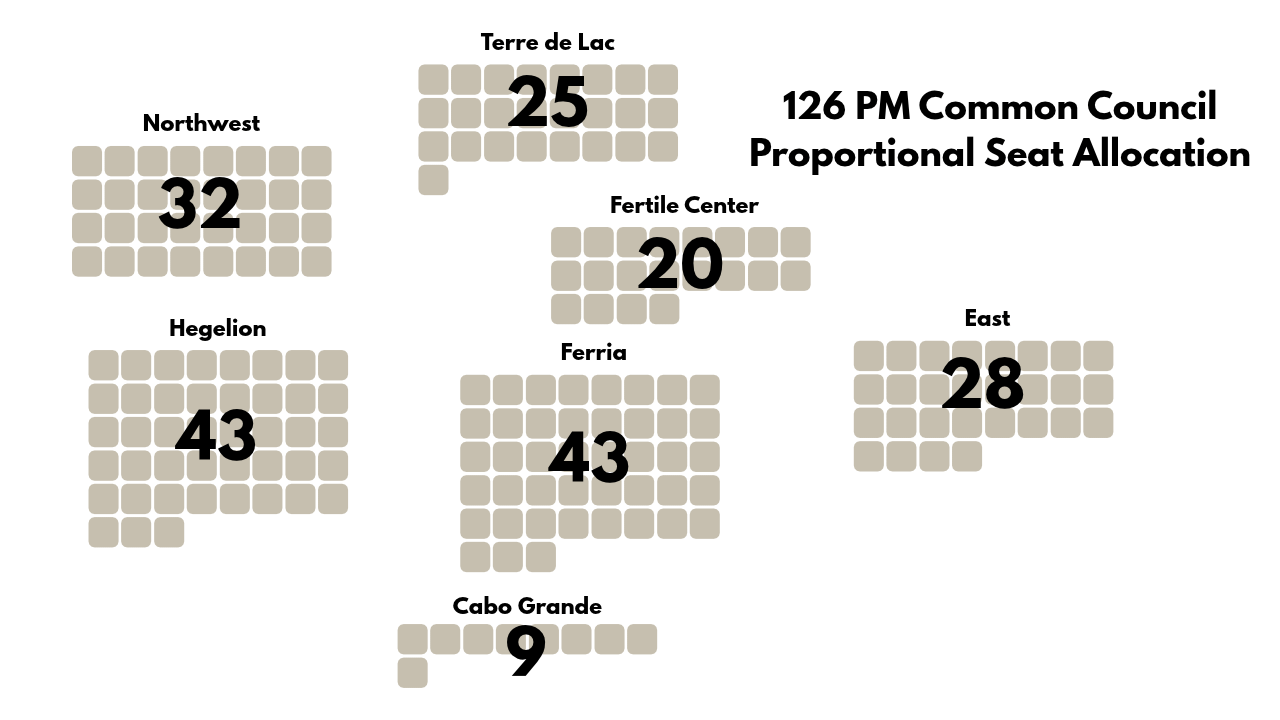
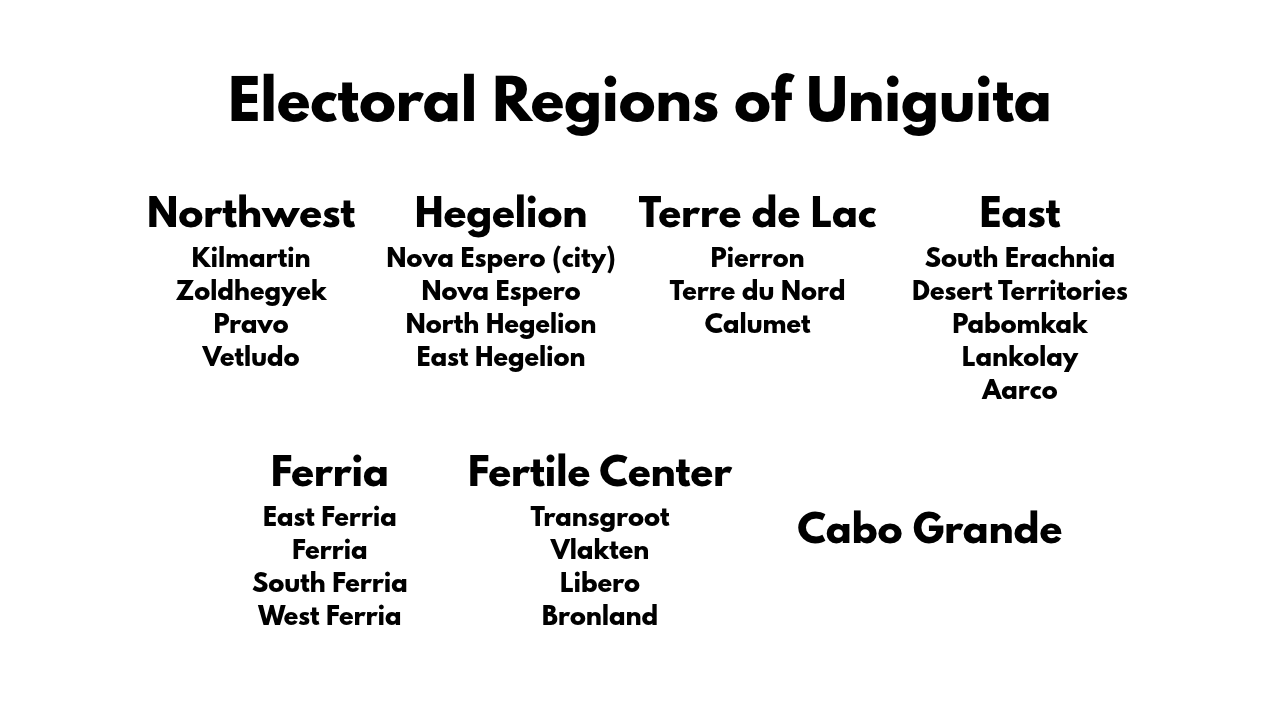
Every two years, the 200 proportionally-elected members of the Common Council are up for election once again. The 200 seats are divided between seven different cultural and linguistic regions across the federation, with each region receiving a number of seats proportional to population according to the most recent census. Ferria and Hegelion, being the nation’s most populous regions, receive 43 seats each, whereas the comparatively less populous Cabo Grande receives just 9, for example.
In each region, the voter receives a ballot (Sheet 1) with each party’s candidates listed in an order set by the party. They can either 1) rank individual candidates from any list in order of preference up to the number of seats allocated to each region or 2) vote for a party, which will cast their ballot for all members of that party’s list. In large regions like Hegelion and Ferria (43 seats each) voters will typically only rank their top choices. For the remainder of their unranked votes, they may select an individual party.
This is separate from the quadrennial process (coinciding with the presidential election) in which voters choose who will represent their individual, geographical constituency. Aside from a handful of individual special elections for vacated seats, the vast majority of the 300 constituency seats won’t be up for election for another two years.
Sheet 2 – Commonwealth and local races
Many commonwealths and local governments will be holding their respective elections this year as well. Major commonwealths like North Hegelion, Pierron, Ferria, and all of the Fertile Center will be holding their elections this year, as well as major cities like Nova Espero and Puerto Blanco.
In addition to their federal ballot, voters will receive another ballot (Sheet 2) that contains all of their local and regional races. Some commonwealths have a mixed election system like the federal Common Council, wherein both constituency and proportional seats are elected. Some only have constituency seats, while others only have proportional seats.
Local elections can also be mixed. Some, like Nova Espero, elect their mayor and all members of their city council by two-round runoff elections, while Puerto Blanco uses a mixed-member system like the federal government.
Who are the players?
Because of its mixed electoral system and diverse demography, Uniguita is a multi-party democracy with parties ranging in ideological skew and regional interest. On the federal level, there are six parties represented in the Common Council.
Founded in 46 PM to form a united opposition against then-President Enrico Carmelo, the People’s Party (also known as the Poppies) is the Federation’s dominant center-left political party. The party dominates in the nation’s major urban areas as well as smaller industrial cities and suburbs, particularly along the West Coast, throughout Ferria, and in Pabomkak in the east. The Poppies are heavily influenced by their bases in the union and cooperative movement, with both having seats on the party’s central executive committee. The party still wields some influence in Terre de Lac and Zoldhegyek, though much of it has been supplanted by the Parti Lacaise and the Conservatives respectively.
On the center-right to right lies the Conservative Party. Founded in the early 20s as a coalition of ideological conservatives and those aggrieved by the left-wing Valdes and Kaplo administrations, the Blues as they’re often called have long enjoyed success in the rural and suburban regions of Hegelion, the Ferrian Hill Country, Cabo Grande, and the Fertile Center, with increasing strength in Kilmartin, Zoldhegyek, and the eastern commonwealths. Though taken to the far-right during the presidency of Enrico Carmelo (40-47 PM), the party has gradually become a bastion of center-right conservatism. Even so, the party has come under the increasing influence of the Patriots, a far-right faction seeking to gain further control within the party apparatus.
The Liberal Party is one of the two oldest in the country, founded as the Liberal Association in 4 PM in Nova Espero. Generally at the center of the Uniguitan political spectrum, the liberals favor free market reforms as well as open and evidence-based governance. The Liberals are geographically spread throughout the Federation, though feature most predominantly in the cities and close-in suburbs. The commonwealth of Vetludo is the Liberal stronghold, consistently favoring them over any other party.
The Communalist Party is the second oldest in the Federation, having been founded as the Socialist Labor Party around the same time as the Liberals. Despite its dominance in the 10s and 20s, the Communalists have become a minor party on the national stage. The modern party predominantly favors a Kaploist brand of Communalism, in which the federal government ensures a social safety net and the security of civil and political rights, while local governments are handed the powers for local administrative governance. The party is concentrated nowhere in particular, but historically has its strongest support in Ferria and Pabomkak.
The Lacaise Party (or Parti lacaise in the native Lacaise language) is a regional interests party based in Terre de Lac. Historically left-leaning, the Parti emerged in the 40s as a response to perceived weaknesses within the existing opposition to President Carmelo as well as a desire for more strenuous local advocacy and organization. The Parti does not fit neatly on the left-right axis as it primarily focuses on Lacaise interests more generally rather than a particular political ideology. The Parti has usually been characterized as being left-of-center on most issues, but trends conservative when it comes to preservation of the Lacaise language and customs, and control on international migration to Uniguita.
The Alliance for Nature is an ecological interests party that, despite seeing some strength in the 30s through 50s, has largely dissipated from the national mainstream. The party historically focused on ecological remediation, environmental conservation, and anti-nuclear advocacy. During the 50s and 60s, for example, the AN was a primary driver of the movement to abolish nuclear weapons. During the Pelar administration (60-68 PM), AN federal Coun. Roderick de Bosy served on the Uniguitan government’s team during negotiations with Ylrikia over the Continental Arms Reduction Treaty. In recent decades, however, much of the party’s philosophy has been either absorbed by the other parties of the left or has fallen out of the cultural zeitgeist. The party does still maintain a delegation in the Common Council, but one that shrinks decade by decade.
Right now, the Poppies and the Liberals form a majority coalition within the Common Council, controlling 273 of the chamber’s 500 seats.
What’s at stake
Midterm elections can dramatically change the balance of power at all levels of government. It was the midterms in 122 PM, for example, that pushed the center-left People’s Party to coalesce with the centrist Liberal Party, leading to changes in federal policy and cabinet postings.
This year’s elections could spell the end of the Poppies’ fourteen-year run on unified control of the federal government. Since their victory in the 110 PM midterms, and then in the 112 PM presidential election, the People’s Party has held both the chieftainship of the Common Council and the presidency. Amid a sluggish economy and an ongoing immigration crisis along the nation’s eastern border, however, the popularity of both President Adamo Lojaleco and Chief Joao Polderal have been flagging. The last pre-election polls have the Poppies netting less than a third of the list vote, which if they bore out on Election Day, would be their worst result in decades.
The Conservatives, meanwhile, are hoping for their first entry into government in thirty years. Since their bruising electoral defeat following the civil war in 96 PM, the Blues have been locked out of government. The party’s steep decline began to reverse by the early 100s, however, and in 110 PM they once again became the second largest party in Council. Most polls show them taking the plurality comfortably, though it remains to be seen whether they would be able to form a coalition capable of forming a majority.
One of the most significant question marks in this election is the influence that the ascendant far-right Patriots’ faction will have within the Conservative Party. Though the faction only commands around a quarter of the Conservatives’ constituency seats, an overperformance in the proportional seats could propel them to majority status. In some regions like the Fertile Center and the Northwest, where the Patriots are the strongest, they command the overwhelming majority of list positions on the ballot. In other places like Hegelion and Ferria where the party is more split between the Patriots and the more moderate True Blue faction, the Patriots’ have been encouraging voters to rank the Patriot nominees specifically to ensure their priority in seat allocation.
Most analysts expect there to be some significant changes in government nationwide. It’s up to the Uniguitan voters now to decide how dramatic those changes will be.