



This is Part Two of a series centered on Pavel Tzarkowski’s experiences as a survivor in early Nova Espero entitled “1850-01.” Follow this link to read Part One.
The Survivors Hospital was an austere structure in between the shambles of two rotting office buildings. A thick 10 foot high fence stretched out into the street to form a boundary separating survivors from residents and citizens.
“Hey Tim! I’ve got… nine back here.” the khaki-clad Aid Corps officer shouted to the tired-looking guard at the gatehouse.
“Hey Kate, take them on in.”
As the van pulled forward, Pavel could get a better view. The building appeared to have been a hotel of some kind. An over-weathered awning stretched over a thin driveway, across from which was a small, thickly developed vegetable garden.
Compared to the overwhelming darkness of the adjacent offices, the Hospital overflowed with light. The Tzarkowskis walked into the lobby, basking in the warm glow of ample artificial fluorescent light. To be able to see every nook and cranny in this makeshift refugee receiving station was a form of decadence lost in the Collapse.
At a front desk were two Aid Corps officers, smiling together as they talked about… something. Pavel couldn’t quite remember the last time he smiled like that, a replenished smile brought about by joyous, invigorating conversation and not by delirium or the relief of finding a tin of rotten tuna.
“Hello sir, could you present your identification please?”
Sir? Please? Such pleasantries were another thing Pavel thought died with the bombs.
“Family 1850… 1, 2, 3, 4…” the fair-haired functionary muttered as he combed through the paper cards.
“We are short on availability so you will have to share a room… Room 208 on the second floor. You’ll meet with Doctor Lourdes on the 18th at 11:15 for vaccinations and physicals. Oh, today is the 16th, just so you know.”
“Dinner is still going in the dining room,” the man continued. “Meals are at 8:00, 12:00, and 19:00. There will be an orientation for all of the newcomers at 9:00 tomorrow morning after breakfast. If you have any questions, please feel free to ask.”
Pavel and Elizabeta had both been professors before the war. They always had questions — the first 28 and 26 years of their lives had been an endless array of questions. Combing through incomplete data, taking notes, hypothesizing, performing research tasks — these were their lives just three years ago, years upon years of an unsatiated curiosity and an endless series of question marks.
But now? They were quiet. Dumbfounded really. Scheduled meals and appointments necessitated functioning clocks and the persistent use of a calendar system. Having one room per refugee family necessitated an abundance of beds and rooms, one so large that they could be spared for people with negative clout. Having vaccinations and doctors — not “medics” or “nurses” or “healers” but doctors — necessitated some sort of pharmaceutical catalogue and professionalization.
These were novel rediscoveries for the Tzarkowskis, now familiar only with scarcity. For the first time in their lives, they found themselves with both unsatisfyingly incomplete answers, but with no energy for follow-up questions.
In the dining room, they encountered new rediscoveries: clean plates and tableware, clean cups and something coming from the kitchen that smelled good.
Pavel and Elizabeta fixed themselves and the children trays of food that seemed to glimmer from every vantage point. What appeared to be pork with potatoes, corn, and bread on the side. And most shocking of all — it was fresh. Or at the very least, fresher than anything they’d eaten in months, if not years.
After dinner, the Tzarkowskis made their way to Room 208. Pavel was only slightly disappointed that the elevator wasn’t working. After all, this most minor of minor inconveniences confirmed that this wasn’t a dream, but in fact his wife and children would be sleeping in what appeared to be a warm and safe place.
Opening the door to the room, it was decorated in a way that would be described as “spartan” before the War, and perhaps a bit dingy. Against one wall were queen beds on wire frames, covered in simple sheets and an old quilt that had almost certainly seen better days. Between the two beds stood a wooden end table topped with a lamp that gave off a comforting, orange-yellow glow. On the other side was a disheveled dresser, atop which sat a simple analog clock.
But after two years of hollowed out buses, bombed out warehouses, and makeshift tarpaulins in the wastelands of the city, this room seemed palatial. There was even a small painting hanging over the beds of some countryside meadow awash in sunshine. No doubt this was one of the millions of such prints that were sold to hoteliers across the Empire in the economic boom in the decades prior to the War, and there was no point on the hospitaliers’ part in removing it. But just like something as basic as needing to keep an eye on a clock or receiving paperwork, this dull lifeless painting comforted Pavel in a way he never would have expected.
After they each took a shower in the restroom down the hall — a real shower, not one where ice-cold water was poured into a bucket with holes drilled into the bottom — the Tzarkowskis tumbled into bed.
For the first time in months, Pavel, Elizabeta, Anna, and Filip slept a full night’s sleep.
“Mr. and Mrs. Tzarkowski? This is Peter from the Aid Corps. Breakfast will be served soon.”
This following a brief knock was what awoke the Tzarkowskis at around 7:45 on the morning of Deka 17th, 1768. Outside, Pavel could hear the chiming of bike bells, and the subtle drumbeat of people heading somewhere and in no particular hurry. Though the family’s west-facing room was cloaked in shadow, Pavel watched as the rising sun brought a shimmer to the rain-soaked street below.
Outside the door of Room 208, the Tzarkowskis found four sets of clean clothing accompanied by a type-written sheet and a brief note. It explained that the Tzarkowskis could put their dirty clothes in the bag and an Aid Corps worker would take them to the laundry for washing.
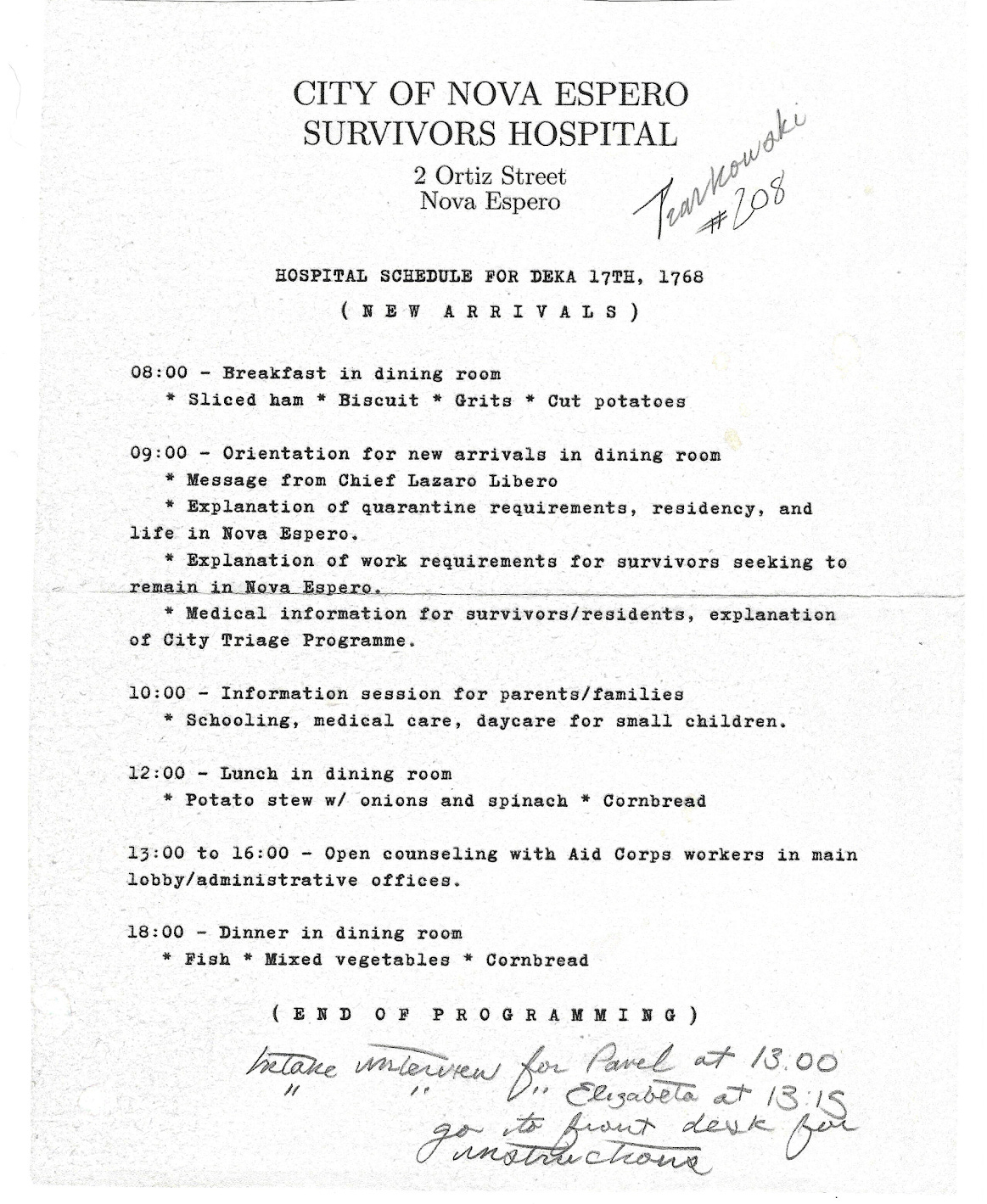
After changing, the family headed downstairs for breakfast. Like the meal from the night before the food was plain, though fresh and hot. Just before 9:00, Aid Corps workers ushered the new arrivals to a dimly lit ballroom with a short stage at its edge. In contrast to the low light of the rest of the room, the stage itself was brightly illuminated revealing a podium adorned with a circular seal bearing a green star in front of a white flag with a green border and green star at its center.
The flag itself seemed pressed and delicately arranged, not something that was haphazardly set up by some ad hoc band of marauders masquerading as a legitimate state. It reminded Pavel of the banner that once occupied the corner of his dean’s office prior to the War, or the various bureaucratic offices of the Empire. It was a minor touch, but a comforting one.
A few minutes after the refugees filed into the chamber, a harried man in a rumpled wool suit approached the podium. The harsh spotlight revealed a chestnut brown head of hair thinning at the forehead, slicked with a light shine of sweat. His face was slightly obscured by a well-groomed beard and mustache, above which were two bright hazel eyes. Despite the anxiety of his general expression, his eyes appeared kindly and calm. To Pavel, he bore some similarity to the awkward history professors at Pavel’s university who were uncomfortable in most social situations but could give an enthusiastic rundown of some medieval war or the architecture of ancient Ylrikian temples at a moment’s notice.
“Hello. And welcome,” the man sheepishly began. “Welcome to Nova Espero. I understand that you are tired and that probably the last thing you want to do is sit through a presentation. I remember that after we got this settlement up and running and we finally had the luxury of security and warm beds again, all I wanted to do was sleep.”
This elicited a brief chuckle from the crowd.
“I will try to keep things as mercifully brief as possible. My name is Lazaro Libero, and I am the chief of the Common Council here in Nova Espero. The citizens of the settlement elected members of the council who in turn elected me to be their leader. Before the War, I was a bureaucrat in the Imperial Public Works Ministry. Many of us in this settlement either came from bunkers under the Imperial ministries or from the tenements of the Old City.
“We number around 2,100 by my last count,” he continued. “Our citizens and residents support one another, offering work to the community through participation in the settlement Guard, through farming, and through scavenging beyond the settlement walls. But we’ve also built back some semblance of civilization: we have theatres, schools, and businesses, artists and the art they produce. And we have boredom. Actual, calm, and honest-to-God boredom.”
A slight, melancholic smile appeared on Chief Libero’s face, as if to say this is what this world has reduced to: a celebration of being able to be bored.
“Today, you’ll learn a little more about our community, the resources available to you, and how you can become a part of Nova Espero – if you want to. At any time, you may leave if you so wish, and go beyond the walls. Though I personally hope you stay. And given the hard work I know our cooks put into the food here, I suspect I won’t have to twist your arm too hard to convince you.”
Another chuckle, another sad smile.
“Sorry I can only be here for such a short time but again, welcome to our community. I hope to see you around.”
Chief Libero sheepishly nodded at the audience, briefly exchanging a handshake with an Aid Corps officer waiting behind him for her turn to speak. He turned back to wave, mouthing the words take care as he departed the stage.
“Good morning everyone!” the ever-cheerful Aid Corps officer began. “Some officers will be going around to pass out informational packets, please take one and pass it around. If you do not speak or read Hegelionic, please tell the officer and we will try to accommodate your language of choice…”
This is Part Two of a series centered on Pavel Tzarkowski’s experiences as a survivor in early Nova Espero entitled “1850-01.” Follow this link to read Part Three.