


“Stop. STOP!”
These were the first words Pavel Tzarkowski heard as he picked through a vehicle in a convoy of scavengers. He and his wife, Elizabeta, had not eaten in four days. His children, Anna and Filip, had eaten their most recent meal two days prior, and Pavel was desperate to make sure that it wasn’t their last.
Pavel had seen these convoys before, and knew that they were hazardous to raid. Before the small settlement he had joined was destroyed just a few weeks earlier, he had heard scavengers refer to them as “high risk, high reward hits,” as they were replete with supplies like medicine, fresh water, and food.
But the common wisdom had been that they were too high risk; they came with an accompaniment of armed guards whose sole mission was to prevent robberies at all costs. Those who were stupid enough to hit them up never seemed to come back.
But being without the support system of an organized settlement, and an increasingly hungry family waiting for him in a hollowed out bus a few blocks away, Pavel was willing to do something stupid.
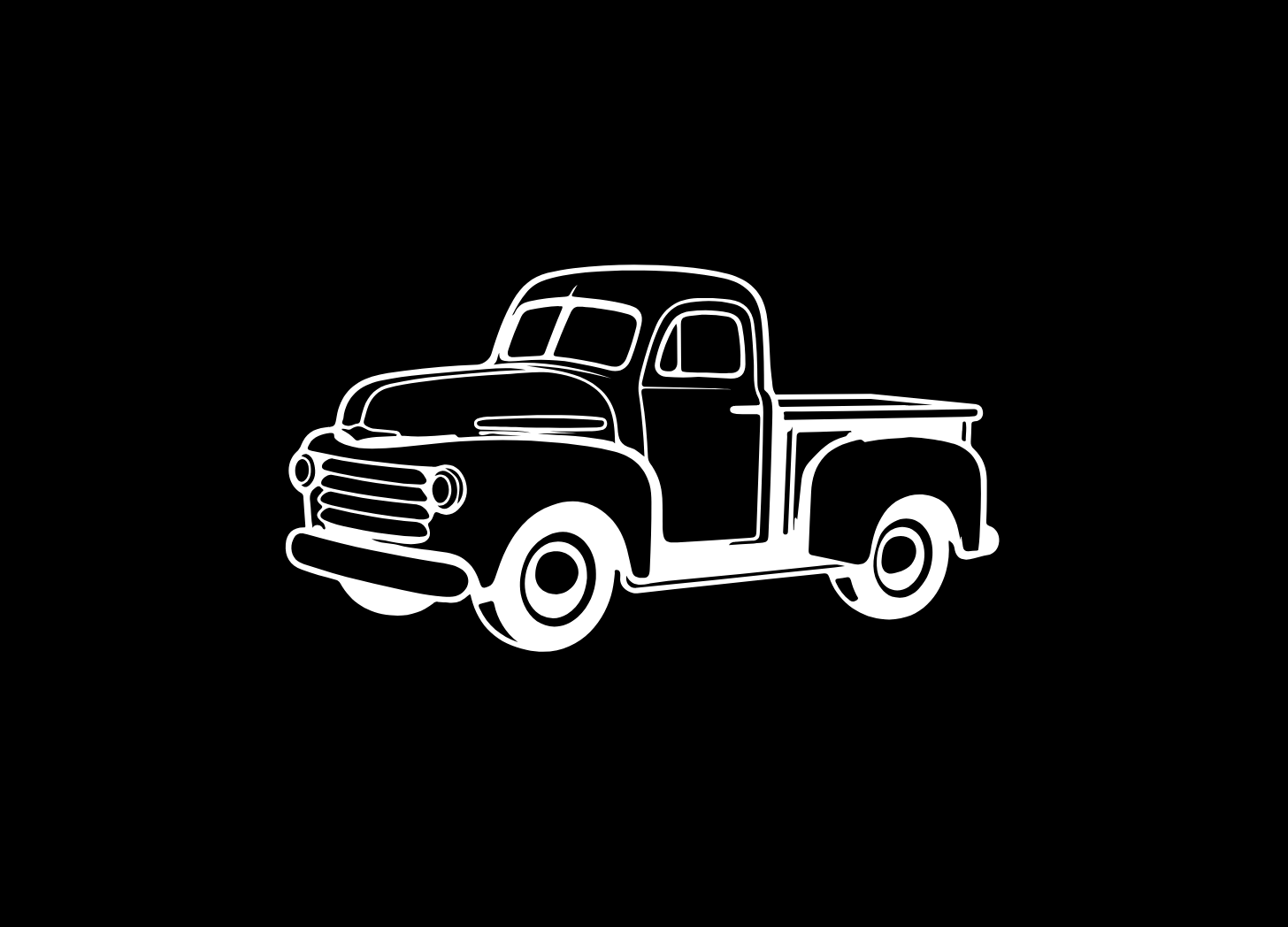
Upon hearing the guard’s command, Pavel hurriedly backed away from the war-worn pickup truck, dropping the damaged can of soup onto the truck bed. They approached him with a shotgun pointed directly at his chest. Pavel could feel his stomach turning inside out.
In the decision between fight or flight, Pavel’s body had chosen freeze. He had no energy to fight back, and even if he did, what chance did an unarmed, malnourished man stand against an apparently well-fed and armed gunman?
Was he about to be executed, made an example by a defender of the modern equivalent of a treasure ship? Would Elizabeta, Anna, and Fil never see their father again, succumbing to malnourishment or the whims of some barbarian raider coming through the area?
Instead, the figure slung the shotgun over his shoulder and pulled a bag out of the truck’s cab.
“Here… there’s some food, some water, and a first aid kit. There’s some electrolyte powder in there too, make sure to mix that with the water… you look pretty rough.”
Pavel was shocked. The past two years had been an unending cycle of scavenging, floating from settlement to settlement, fighting off raiders, and avoiding untimely death. Surviving the war was one thing — surviving the Collapse was another entirely.
“My… my family… they…” was all that Pavel could produce in response.
“How many? I can give you another bag,” said the figure as he nonchalantly reached for another tote from the truck. “It looks like this haul isn’t going to be too great. If your family is nearby, we can take you back to the city with us.”
Pavel had heard promises of safety and health before. Camp after camp, settlement after settlement. The Collapse generation was most vulnerable because they had known the world before the war, and were desperate to get back to it. They had once known abundance, and it had been cruelly ripped away by the uncaring whims of emperors in faraway places.
Now they faced violence and starvation in a way they had previously not thought possible. Full pantries and iceboxes had been replaced by scrounging through abandoned stores, homes, and warehouses. Fighting or killing people whose only crime was not dying on the day of the War was not an infrequent occurrence.
Now, a uniformed man from one of those treacherous treasure convoys was reaching out to him — and Elizabeta, Anna, and Filip — with an open hand. An unqualified open hand. Even after going through what he had gone through, what choice did he have?
Pavel retreated back to the bus, and handed his emaciated wife and children the aid bags. He told them about the convoy and about the soldier’s offer. Elizabeta was the more skeptical of the two, and had correctly clocked dangerous situations before. But she had watched her children writhe and complain from hunger pains for two days. Anna seemed to have an infection from a nasty cut she had received a few days prior. What choice did she have? They could either face a certain and slow demise, or gamble on some kind of life with the convoy, wherever they were going.
A short while later, the Tzarkowskis approached the convoy as its members loaded up what loot they found in the idling pickup trucks and vans. A group of men and women in fatigues with toolbelts, construction helmets, and ruddy work gloves piled into waiting vans, taking sips of water as they walked. The soldier greeted Pavel again, introducing himself to the whole shivering family.
“My name is Captain Luco Tavarek with the 2nd Company of the Nova Espero Guard — would you like to come with us?”
Ambling through the debris-riddled thoroughfares of what was at one time the great imperial capital of Hegeliopolis, the Tzarkowskis and the scavengers made their way towards the settlement at the end of the Hegelion Peninsula. Once a booming metropolis home to over ten million people, the city had been reduced a husk of its former self by the War.
The convoy meandered along the main avenue going into the city center, the stately manors and offices that once lined the corridor replaced by burned out husks and smashed in doors leaking out their hastily looted contents. The trucks and vans swerved to avoid the hollowed out remains of long-torched vehicles and buses, as well as the other detritus generated by bombings nearby
About an hour after departing, the crew approached what appeared to be a large, defensive barrier made primarily of debris, old buses, and trolleys piled on top of one another, and razor wire. From the backseat of the van that was likely ancient even before the war, Pavel could see spotlights emanating outward from the top of the ramparts. Periodically, their glow was broken by pairs of guards pacing by.
A group of men departed a squat, brick building at the ramparts edge, walking up to the various driver’s windows requesting identification papers. Capt. Tavarek explained to one of the orderlies that he had a couple “survivors” in the back of the van. The family departed the vehicle as the captain assured them that they would merely need to fill out and receive some paperwork and they’d soon be on their way.
Accompanying the man — the boy, as Pavel thought to himself, noting that he couldn’t have been more than a teenager – the Tzarkowskis entered what appeared to be a surprisingly well-lit office staffed with a variety of olive- and khaki-clad personnel. The boy soldier escorted the Tzarkowskis over to a desk marked “Survivor Processing.”
“Captain Tavarek found these people out on a scavving mission… has the bus for the hospital left yet?”
“No, no” the kindly woman, maybe a few years younger than Elizabeta said. “It’ll leave soon though, I’ll get their cards done as soon as possible.”
The woman — a lieutenant in what Pavel learned was called the “Aid Corps” — collected some very basic biographical information from the Tzarkowskis before handing them their “survivor identification cards.” Pavel was 1850-01, Elizabeta was 1850-02, Anna 1850-03, and Filip 1850-04.
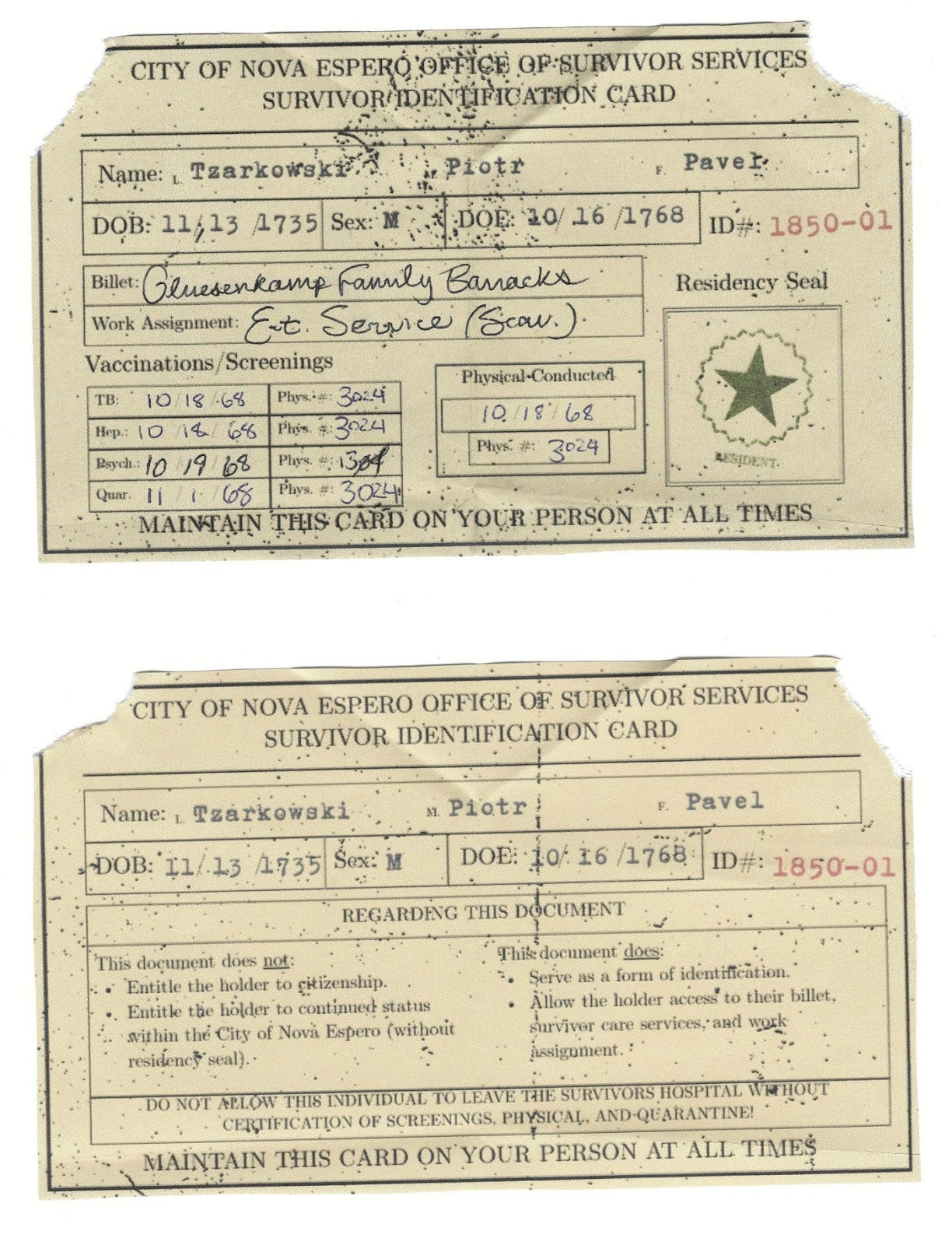
For the next thirty minutes, the family sat in a back holding area that was stocked with water, some small snacks, and electrolyte powder. That they were giving these things away shocked Pavel; generosity and charity weren’t exactly to be expected in the Collapse.
They even had hot water and tea — tea! Back when he was a college professor before the War, Pavel could drink an entire quart of the stuff before noon every day, and another in the afternoon. The bags weren’t fresh, but he didn’t care — stale tea was better than the canned or polluted water and alcohol he had been sustaining himself with for the past two years.
“Alright everyone,” the Aid Corps officer chirped to the ragamuffin assortment of families and individuals waiting in the holding area. “Please follow me to the bus; we’ll get you to a warm meal and a warm bed in no time.”
All of them, in threadbare clothes and with dirty faces bearing the weight of two years of uninterrupted exhaustion shambled towards the dingy, white bus just outside. Some fell asleep as the creaking vehicle slipped through the streets of a primordial Nova Espero. Pavel saw people walking in the street — at night! — seemingly without firearms or without fear. Even through the rain-soaked and lightly fractured windows of the shuttle, he could see that they even had smiles on their faces. When he squinted, he swore he could make out the signboard of what appeared to be theatre.
What is this place? Pavel thought to himself.
This is Part One of a series centered on Pavel Tzarkowski’s experiences as a survivor in early Nova Espero entitled “1850-01.”